
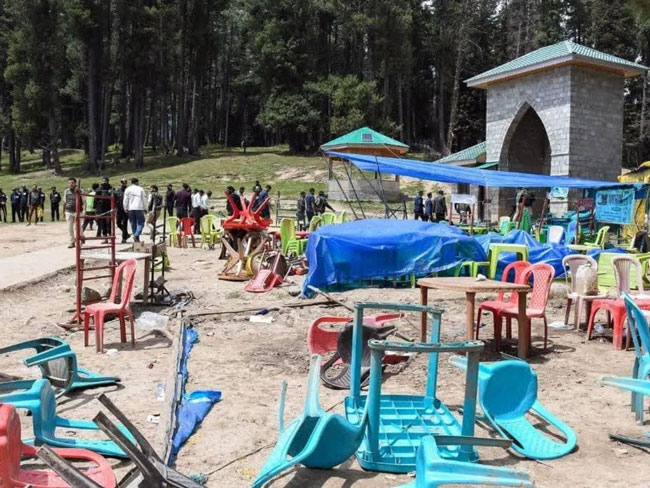
New Delhi : The National Investigation Agency (NIA) has made significant revelations in its ongoing probe into the Pahalgam terror attack, uncovering how the conspiracy was allegedly planned using trekking applications, encrypted coordination, and cross-border supply networks involving weapons and drones.
According to findings reported in the investigation, the attackers used navigation and trekking-based mobile applications to conduct detailed reconnaissance of the Baisaran Valley area in Jammu and Kashmir, which later became the site of the deadly assault. The digital trail indicates that the location was studied in advance through saved routes, screenshots, and app-based mapping tools.
Investigators have also found indications that drones were used in the broader terror ecosystem linked to the attack for the delivery of weapons, ammunition, and funds across the border. The NIA chargesheet suggests that such unmanned aerial systems were part of a growing trend in cross-border terror logistics, allowing material support to reach remote areas with reduced risk of interception.


The probe further reveals that modern communication methods, including radio-based systems, were used by the terrorists instead of conventional mobile networks, making detection more difficult. Forensic analysis reportedly found minimal or no digital communication traces on recovered devices, indicating operational discipline and pre-planned communication security.
The investigation has also uncovered that GoPro action cameras and other surveillance devices were used by terror operatives, allegedly to record movements and possibly for propaganda purposes. Officials are examining how such equipment was sourced and routed through international supply chains before reaching the attackers.
The NIA has identified Pakistan-based Lashkar-e-Taiba operative Saifullah alias Sajid Jutt as the alleged mastermind who coordinated the attack and maintained real-time contact with the ground operatives. He is said to have provided instructions and location guidance during the operation.
Two local individuals have also been named in the chargesheet for allegedly providing shelter and logistical support to the attackers shortly before the incident, though they have denied any involvement.
The Pahalgam attack, which took place in April 2025, resulted in multiple civilian casualties and remains one of the most serious security incidents in the region in recent years. Investigators continue to trace financial, technological, and logistical networks believed to have supported the operation.