
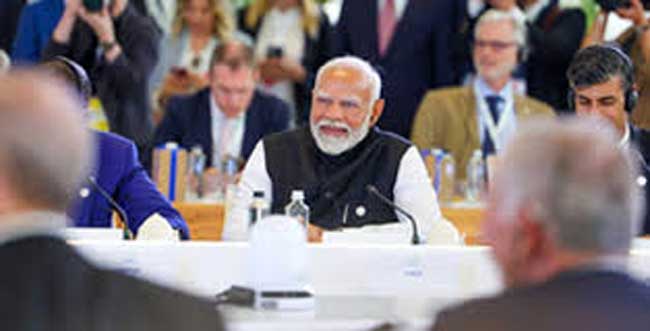
The G7 presents itself as an exclusive club of the world’s most advanced economies, shaping global decisions and setting the tone for international governance. Yet, in the 21st century, one contradiction stands out clearly—India, despite not being a formal member, has become indispensable to almost every major global conversation led by this group.
The real question is no longer why India is outside the G7. The real question is why the G7 increasingly appears incomplete without India.
A New Grammar of Power
The traditional definition of power—military dominance and industrial wealth—has undergone a deep transformation. In today’s world, power is defined by economic resilience, demographic strength, technological capability, and diplomatic flexibility.
India now stands at the intersection of all these dimensions. Whether or not it holds a formal seat at elite tables, its presence shapes the agenda of those very tables.
Not Just a Country, But a Bridge
India’s unique geopolitical position lies in its ability to connect two vastly different worlds. On one side are developed Western economies; on the other, the vast and diverse Global South.
India does not merely represent itself—it often represents a broader voice of developing nations while maintaining engagement with advanced economies. This dual positioning gives India a rare diplomatic advantage: it is both participant and bridge.
Strategic Autonomy: Walking Its Own Path
One of India’s defining foreign policy principles is strategic autonomy. Unlike many nations aligned rigidly with one bloc, India maintains balanced relationships across power centers—engaging with the United States, Europe, Russia, and Asia simultaneously.
This independence allows India to act not as a follower of global decisions but as a shaping force within them.
Population as Power, Not Burden
What was once described as India’s biggest challenge—its population—has become one of its greatest strengths.
India today represents the world’s largest consumer market and one of its youngest workforces. Global companies no longer treat India as an emerging option; they treat it as a central pillar of future economic growth.
A Changing Global Order
The G7 reflects a post-war world order that concentrated global influence in a handful of industrialized nations. That structure no longer defines reality.
The world has become multipolar, with power distributed across regions rather than concentrated in a single bloc. In this shifting order, India’s rise is not an exception—it is a defining feature.
Present Without a Seat
India may not hold formal membership in the G7, but its influence is deeply embedded in discussions on climate change, digital governance, energy security, and global supply chains.
This creates an undeniable paradox: participation without membership, influence without formal authority.
Final Perspective
India today occupies a unique geopolitical space. It does not wait for invitations to shape global conversations; rather, global conversations increasingly adapt to India’s presence.
This is not just India’s rise—it is a reflection of a changing world order where legitimacy is no longer defined by closed groups, but by real influence and necessity.