
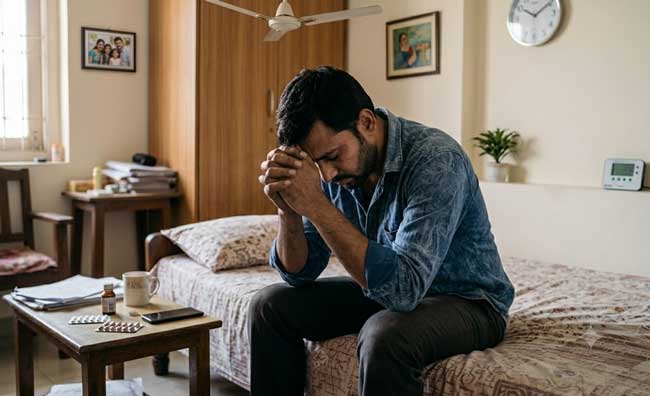
A troubling pattern is emerging in India’s social fabric—an increase in suicides linked to marital and family-related stress. While suicide is a complex and multi-layered phenomenon, recent discussions and data referenced from the National Crime Records Bureau indicate that disputes within marriage, separation, allegations of infidelity, financial strain, and prolonged domestic conflict frequently appear in the background of such tragedies.
What makes this trend particularly concerning is the disproportionate vulnerability observed among men. This is not a simplistic gendered argument, but a reflection of structural and emotional realities that demand urgent attention.
In India’s traditional social framework, men are often conditioned to be the primary economic providers and emotional anchors of the family. This expectation, while culturally ingrained, leaves little space for emotional fragility, vulnerability, or open expression of distress. When marital conflict arises—whether through separation, legal proceedings, or breakdown of trust—the psychological burden often becomes compounded by social silence.


Men, in many cases, are less likely to seek psychological help or counseling. Emotional expression is frequently discouraged, either subtly through cultural norms or explicitly through social judgment. As a result, distress tends to accumulate internally, manifesting as isolation, anxiety, depression, and in some cases, self-destructive thoughts.
Another critical dimension is the limited accessibility and normalization of mental health support within family and marital disputes. These conflicts are still predominantly treated as legal or moral issues rather than psychological crises. Courts and mediation systems may address the formal aspects of separation or dispute, but emotional trauma often remains unacknowledged and untreated.
Experts in mental health emphasize that this gap between legal resolution and emotional recovery is where many individuals become most vulnerable. Without timely counseling or empathetic intervention, conflicts that are procedural in nature can evolve into prolonged psychological distress.
Society’s response to such tragedies also reflects a deeper issue: the tendency to interpret suicide through moral judgment rather than mental health understanding. This framing not only stigmatizes the deceased but also discourages those in distress from seeking help. Suicide, in such contexts, is not an isolated act of individual failure but a signal of systemic neglect in addressing emotional well-being.
What is urgently required is a shift in how marital and family conflicts are perceived and handled. Counseling must become an integral part of dispute resolution mechanisms. Mental health support should be accessible not only in clinical settings but also within legal, familial, and community frameworks. Schools, workplaces, and local institutions must normalize conversations around emotional distress, especially for men who are socially conditioned to remain silent.
At a broader level, redefining masculinity in more humane terms is essential. Strength cannot continue to be equated with silence, endurance without expression, or responsibility without emotional support. A society that expects men to carry burdens alone must also accept responsibility for the consequences of that isolation.
This is not merely a family issue or a legal issue. It is a public health concern and a social design failure that requires immediate, coordinated attention.
Only when emotional health is treated with the same seriousness as physical and financial well-being can such silent crises begin to recede from the shadows.