
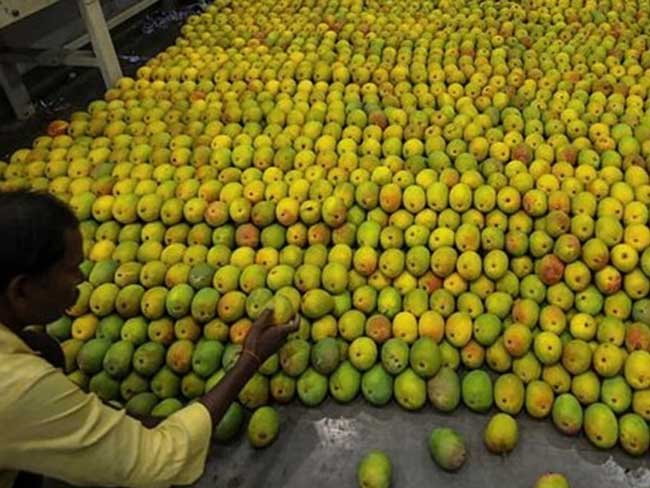
Reports over the past few days regarding the export of Indian mangoes to Nepal had created considerable confusion among farmers, traders, and exporters. Some media outlets claimed that Nepal had imposed a ban or temporarily suspended the import of mangoes from India. However, the Indian Ministry of Agriculture and Farmers Welfare has now clarified the situation, stating that no such restriction has been imposed by Nepal and that these reports are completely misleading and factually incorrect. At the same time, Nepal has introduced certain updated import regulations. The clarification has brought significant relief to stakeholders, as Nepal is considered an important market for Indian mangoes.
What rules is Nepal asking to follow?
Nepal’s National Plant Protection Organization (Plant Quarantine and Pesticide Management Center) clarified on 10 June 2026 that there is no ban on the import of Indian mangoes. Imports continue as usual, but compliance with phytosanitary (plant health) regulations is mandatory. Importers are required to present a valid phytosanitary certificate issued by the Government of India, after which import permits and release orders are being issued.
Trade between the two countries continues normally
Data shows that exports of Indian mangoes to Nepal are ongoing without disruption. From January 2026 to date, around 2,005 metric tonnes of mangoes have been exported to Nepal in 149 shipments. In June 2026 alone, 266 metric tonnes were sent through 18 shipments. These figures clearly indicate that trade between the two countries remains stable and uninterrupted, with no restriction in place.


Nepal has introduced some new import rules
However, Nepal has recently implemented certain updated import requirements. The most significant among them is the mandatory “Hot Water Treatment (HWT)” process. Under this procedure, mangoes are treated with hot water before export to eliminate pests and diseases. India is complying with these requirements to ensure smooth continuation of exports.
At the same time, the Indian government has expressed concern that Nepal introduced these phytosanitary measures without adequate prior consultation. India has raised this issue under the World Trade Organization (WTO) SPS Agreement and the International Plant Protection Convention (IPPC) framework through appropriate bilateral channels.
Experts note that Indian mangoes enjoy strong demand in Nepal, and agricultural trade between the two countries has historically been robust. In such a scenario, any misinformation can harm farmers and traders significantly. The Ministry has therefore urged all stakeholders and the public to rely only on official sources for trade-related updates and avoid unverified reports circulating on social media.
In conclusion, there is no restriction on the export of Indian mangoes to Nepal. Trade continues normally, and the mango trade between India and Nepal will proceed as before. This clarification comes as a major relief for farmers who depend on neighboring markets like Nepal for their agricultural produce.