
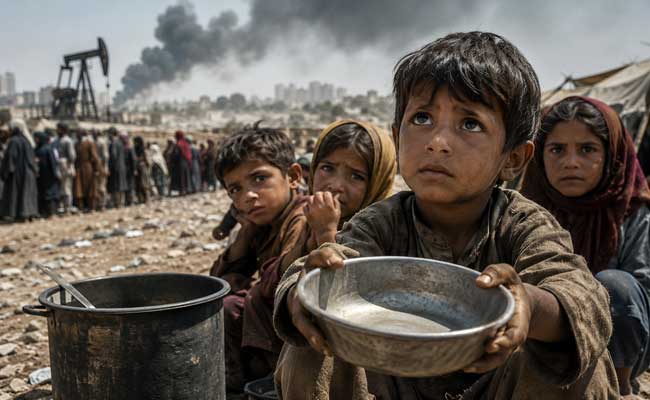
The warning issued by the United Nations World Food Programme (WFP) is not merely another entry in the long catalogue of global crises—it is a stark reminder that modern conflicts no longer remain confined within borders. They travel through oil markets, ripple across supply chains, and ultimately arrive at the dinner tables of the world’s poorest families.
According to the agency, the ongoing conflict involving Iran is amplifying global food insecurity by driving up fuel and food prices. In an already fragile global economy, where millions were struggling with inflation and debt burdens, this additional shock is pushing vulnerable populations closer to the edge of survival.
The numbers are sobering. The WFP estimates that an additional 2.5 million people in Somalia, 2.3 million in Afghanistan, and 1.3 million in Sri Lanka are now facing difficulty meeting basic food needs as the economic fallout spreads. These are not isolated statistics; they reflect a broader pattern of systemic vulnerability in countries where even minor price fluctuations can determine whether families eat or go hungry.


Earlier projections by the agency suggested that up to 45 million more people could fall into food insecurity by the end of June, adding to an already staggering 318 million people experiencing acute food shortages worldwide. The fact that these projections are now being reaffirmed underscores the persistence—and potential escalation—of the crisis.
At the heart of this crisis lies a simple but brutal equation: higher energy costs lead to higher food prices. As WFP Acting Executive Director Carl Skau noted, in many low-income countries, households already spend the majority of their income on food. When prices rise further, there is little room for adjustment except through reduced consumption. That reduction translates directly into malnutrition, hunger, and long-term developmental harm, particularly among children.
The crisis is not limited to a single region. The Middle East conflict has created economic shockwaves that extend far beyond its immediate geography. Disruptions in trade routes, volatility in fuel markets, and rising transportation costs are collectively eroding food security in countries already weakened by poverty, climate stress, or political instability.
Regions such as Sudan, Gaza, southern Lebanon, Yemen, and Haiti continue to remain on the WFP’s list of acute concern. Each of these places carries its own layered crises—conflict, governance failures, climate shocks—but the global inflationary pressure has added another layer of hardship, making recovery even more difficult.
Yet, amid the worsening conditions, another equally troubling issue is emerging: funding shortfalls. The WFP has been forced to scale back assistance programs for millions due to insufficient donor contributions. In humanitarian terms, this represents a dangerous contradiction—just as needs are rising, the capacity to respond is shrinking.
The agency’s appeal to international donors is therefore not just administrative—it is urgent. In Somalia and Afghanistan in particular, reduced aid could translate into immediate and severe consequences for populations already living on the brink.
What makes this crisis particularly alarming is its interconnected nature. It is no longer possible to separate geopolitical conflict from humanitarian outcomes, or energy markets from food security. They are now part of a single, interdependent system where instability in one region can trigger hunger in another thousands of miles away.
The WFP’s warning should therefore be read not only as a forecast, but as a call for collective responsibility. Without coordinated international action—both to stabilize conflict zones and to ensure sustained humanitarian funding—the world risks allowing a preventable hunger crisis to deepen into a defining tragedy of this decade.