
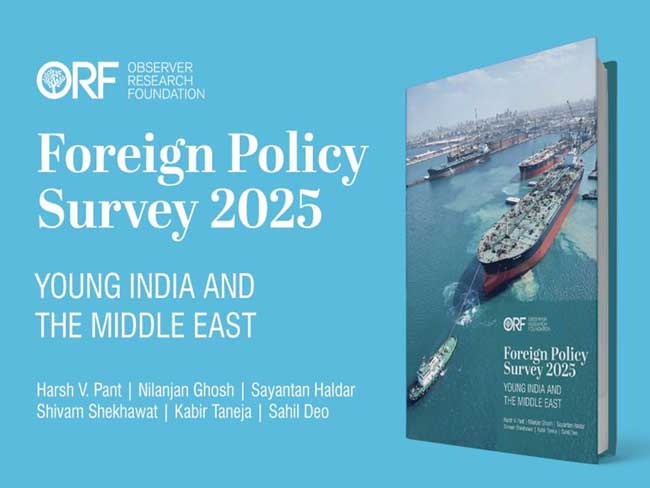
The Foreign Policy Survey 2025 by the Observer Research Foundation offers more than statistical snapshots of youth opinion; it reflects a deeper ideological consolidation among young Indians on questions of security, sovereignty, and global positioning. What emerges is not merely support for specific policy actions, but an increasingly structured worldview—one that prioritizes assertiveness in national security, pragmatic multilateralism, and selective global partnerships.
Foremost among the findings is the overwhelming support for India’s security posture, particularly actions such as Operation Sindoor, undertaken in response to cross-border terrorism. Within the survey narrative, such responses are not viewed as isolated military or diplomatic episodes, but as necessary assertions of strategic deterrence. For a large section of urban youth, restraint is no longer equated with strength; calibrated retaliation and visible state resolve are now seen as essential components of credible foreign policy.
Equally significant is the consensus around the perceived security threat environment, with Pakistan-sponsored terrorism and China identified as persistent challenges. This framing indicates that geopolitical awareness among young respondents is deeply anchored in hard security realities rather than abstract diplomatic ideals. The endorsement of measures such as placing the Indus Waters Treaty in abeyance further underscores a shift toward leveraging all instruments of statecraft—economic, diplomatic, and resource-based—in response to security provocations.


On the global governance front, the survey highlights a strong and consistent demand for structural reform, particularly regarding expansion of the United Nations Security Council and India’s bid for permanent membership. This reflects not anti-multilateral sentiment, but rather a desire to reshape existing institutions to better reflect contemporary power distributions. In parallel, continued support for the United Nations and other multilateral platforms suggests that young Indians are not rejecting global institutions; they are demanding recalibration, not replacement.
Perhaps the most striking evolution lies in India’s perceived external partnerships. The declining trust in the United States as the most reliable partner, alongside rising confidence in Russia and Japan, signals a pragmatic recalibration rather than ideological realignment. Even more telling is the sustained optimism around BRICS as an alternative global framework, indicating that young Indians are increasingly comfortable with a multipolar world where alignments are fluid and interest-driven rather than bloc-based.
The Middle East emerges as a defining horizon in this evolving worldview. Its growing importance is not limited to energy or remittances, but extends to investment flows, infrastructure partnerships, and technological collaboration. Frameworks such as IMEEC and I2U2 are seen as strategic enablers rather than diplomatic abstractions. The United Arab Emirates, in particular, stands out as a model partner—economically dynamic, politically stable, and increasingly integrated into India’s developmental imagination.
Taken together, the survey paints a portrait of a generation that is neither inward-looking nor passive in global affairs. Instead, it is increasingly confident, strategically aware, and willing to endorse assertive policy choices when framed within national interest. The underlying message is clear: India’s young population is not just observing foreign policy—it is actively shaping the intellectual boundaries within which that policy is expected to evolve.