

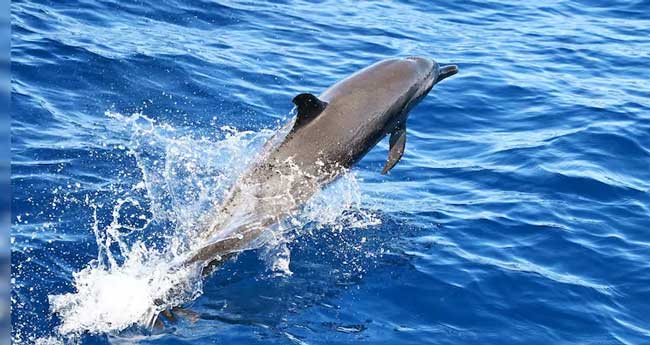
In the already tense geopolitical theatre of West Asia, where real missiles, drones, naval deployments, and sanctions shape outcomes, a strange headline recently entered global discourse—claims that Iran could deploy “kamikaze dolphins” against US warships in the Strait of Hormuz. The story, circulated through secondary reporting and amplified in commentary spaces, was quickly met with official dismissal from the United States. Yet, the very fact that such a claim gained attention reveals something deeper than its factual credibility.
At one level, the allegation itself sits on fragile ground. There is no verified evidence that Iran maintains any offensive program involving weaponised marine mammals. Even the broader suggestion of “military dolphins” is largely speculative when placed against publicly available data. What exists in documented history is far more conventional: the United States Navy’s long-running Marine Mammal Program, which has trained dolphins primarily for mine detection and underwater object recovery—tasks that are defensive and logistical in nature.
The US response to the claim was equally telling. Defence Secretary Pete Hegseth rejected the notion outright, stating there was no evidence of such capabilities. Yet his additional, somewhat ironic remark—refusing to confirm or deny whether the United States has any comparable capability—added a layer of performative ambiguity. In modern strategic communication, even denial is rarely just denial; it often carries an element of signalling, humour, or psychological framing.
This episode reflects a broader trend in contemporary conflict narratives: the blending of verified military facts with speculative or sensational elements that travel faster than official clarification. In an age where information circulates instantly and often without filtration, unusual claims—no matter how improbable—can become part of the strategic noise surrounding real geopolitical rivalries.
The Strait of Hormuz, where this story is geographically anchored, is not an ordinary waterway. It is one of the most critical energy corridors in the world, carrying a significant share of global oil trade. Any tension in this region—whether grounded in military movement or media speculation—inevitably draws international attention. This sensitivity creates an environment where even unconventional or unverified narratives gain traction.
It is also important to distinguish between operational military capability and narrative warfare. Modern geopolitics is not shaped only by ships and missiles, but also by perception, messaging, and psychological framing. In such an environment, even implausible ideas can serve a purpose: they reflect fears, test reactions, or simply circulate as part of the informational ecosystem that surrounds conflict zones.
However, stretching imagination too far into the realm of the absurd risks diluting focus from the real issues at stake in the region—maritime security, nuclear diplomacy, sanctions regimes, and the fragile balance of deterrence that governs US-Iran relations.
Ultimately, the “kamikaze dolphins” story is less about marine mammals and more about the information age itself. It illustrates how quickly unverified claims can enter serious geopolitical conversation, and how states are often forced to respond not only to threats on the water, but also to narratives in the air.
In the end, what remains clear is this: there is no confirmed evidence of such a programme, and most defence analysts regard the claim as speculative at best. But its circulation serves as a reminder that in modern conflicts, perception can sometimes travel faster than truth—and occasionally, louder than facts themselves.