

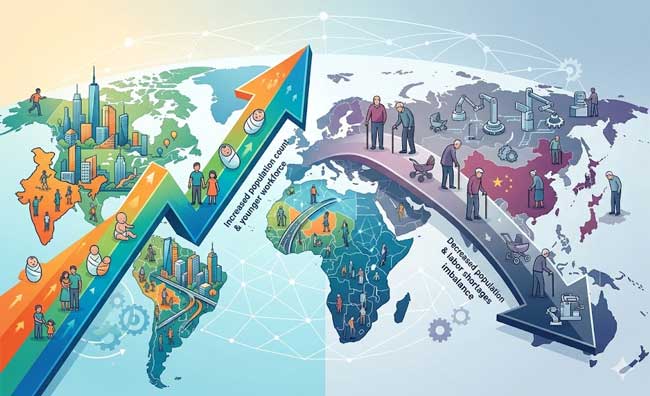
By 2050, the global population is expected to undergo a significant transformation, reshaping economic, social, and political dynamics across the world. According to United Nations and demographic projections, the world population may reach around 9.7 billion. However, this growth will not be evenly distributed—some countries will experience rapid expansion, while others will face steady decline.
India to Remain the Most Populous Nation
India is projected to remain the world’s most populous country in 2050. At present, India’s population is around 1.4 billion, and it is expected to rise to approximately 1.6 to 1.7 billion by mid-century.
However, India’s population growth rate is slowing due to declining fertility rates. Despite this, the country continues to benefit from a large young population, which can support economic growth. At the same time, challenges such as employment generation, urbanization, and resource management will become increasingly important.


China Facing Population Decline
China, long the world’s most populous nation, is now entering a phase of demographic decline. By 2050, its population is expected to fall to around 1.25 to 1.30 billion.
Low birth rates, the long-term effects of population control policies, and a rapidly aging society are major concerns. The shrinking workforce and rising burden on healthcare and social security systems may create serious economic challenges in the coming decades.
Japan: A Rapidly Aging Society
Japan stands as one of the clearest examples of population decline and aging. The country has consistently recorded low birth rates and an increasing proportion of elderly citizens.
By 2050, Japan’s population is expected to decline further, potentially falling below 100 million. This trend is already impacting the labor market and increasing pressure on social welfare systems. Japan is increasingly relying on automation and advanced technology to address these challenges.
Africa and Parts of Asia Driving Growth
While East Asia and parts of Europe face population decline, several countries in Africa and South Asia are expected to experience strong population growth.
Countries such as Nigeria, Ethiopia, and Pakistan are projected to contribute significantly to global population increases. This shift may also influence global economic and geopolitical balance in the future.
Emerging Global Challenges
The demographic landscape of 2050 will bring several major challenges:
- Rapid population aging in developed nations
- Declining workforce in key economies
- Increased migration and urbanization pressures
- Rising strain on healthcare and pension systems
Conclusion
The year 2050 will mark a major demographic turning point for the world. While countries like India and several African nations will continue to grow, China, Japan, and much of Europe will face shrinking populations. These contrasting trends will reshape global economic power, labor markets, and international relations in profound ways.