
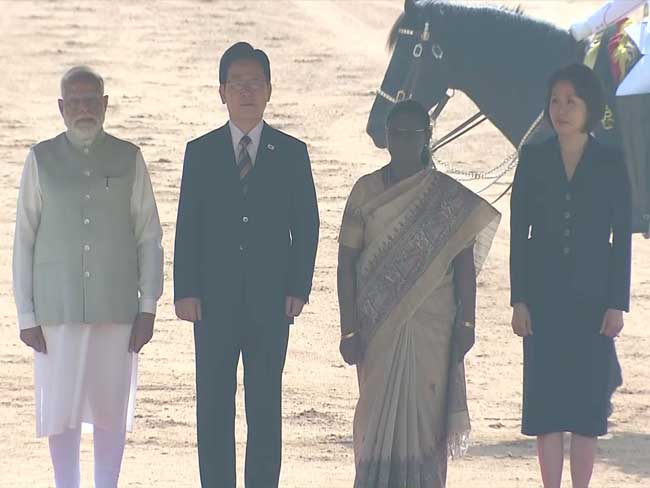
New Delhi: South Korean President Lee Jae Myung was accorded a ceremonial welcome at the forecourt of Rashtrapati Bhavan on Monday, marking the formal start of his three-day state visit to India.
Prime Minister Narendra Modi and President Droupadi Murmu were present at the grand reception held in the national capital. The visiting leader was accompanied by First Lady Kim Hea Kyung during the ceremonial event.
Following the official welcome, President Lee is scheduled to visit Rajghat to pay homage to Mahatma Gandhi. His India visit, the first by a South Korean head of state in over eight years, underscores renewed momentum in bilateral relations.
Earlier on Sunday, upon his arrival in New Delhi, President Lee met members of the Korean community and expressed optimism about the upcoming India–Korea summit. He said the meeting could serve as a turning point in elevating bilateral ties to a new level.
Highlighting India’s growing global role, Lee noted that the country is no longer just a consumer market but has emerged as a key driver of global production and supply chains. His remarks come amid expanding economic and strategic cooperation between the two nations.
According to the Ministry of External Affairs, the visit is an important milestone in strengthening the India–South Korea Special Strategic Partnership.
President Lee, who assumed office in June 2025, began his official engagements by meeting External Affairs Minister S. Jaishankar. The main focus of the visit will be the bilateral summit with Prime Minister Narendra Modi at Hyderabad House.
The discussions are expected to focus on expanding cooperation in key sectors such as semiconductors, defence manufacturing, green energy, and enhancing trade ties under the Comprehensive Economic Partnership Agreement (CEPA).
Both sides are expected to issue a joint statement outlining the future roadmap of bilateral relations. President Lee will also participate in a business forum at Bharat Mandapam and later call on President Droupadi Murmu.
India and South Korea elevated their ties to a “Special Strategic Partnership” in 2015, and cooperation has since expanded across infrastructure, technology, and manufacturing sectors.