
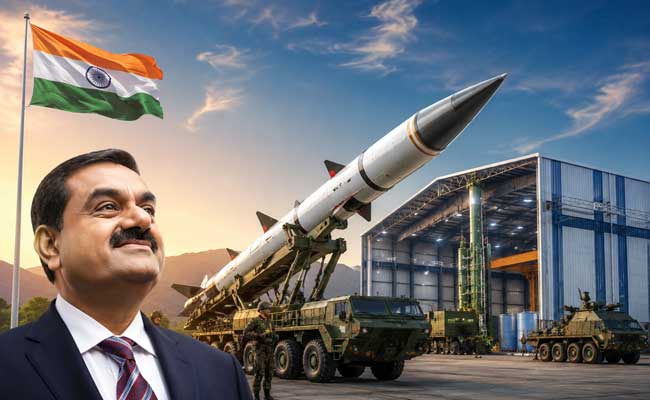
The ₹2,500 crore defence manufacturing project launched by Adani Defence & Aerospace in Shivpuri, Madhya Pradesh, represents far more than a large-scale industrial investment. It signals a structural shift in India’s defence production ecosystem—one where private enterprise is no longer a peripheral participant but an increasingly central actor in strategic manufacturing.
Positioned as one of South Asia’s largest integrated private missile production ecosystems, the project is designed with an ambitious “end-to-end” architecture. From raw material processing to final assembly and systems integration, the entire production chain is expected to operate within a single advanced industrial complex. This integrated model marks a departure from the traditionally fragmented structure of defence manufacturing, where different stages of production are often distributed across multiple public and private facilities.
At the policy level, the project aligns closely with India’s broader “Make in India” and “Atmanirbhar Bharat” vision, which seeks to reduce import dependency in critical defence technologies. For decades, India’s advanced missile systems and defence-grade components have relied significantly on foreign suppliers. The emergence of large-scale private infrastructure in this domain indicates a deliberate attempt to internalize high-end defence capabilities within the country.


The foundation-laying ceremony, attended by senior political and administrative representatives, underscored the strategic weight attached to the project. It was not presented merely as an industrial milestone but as part of a broader national security and technological self-reliance agenda. Such positioning reflects the evolving relationship between the state and private defence manufacturers, where collaboration is increasingly framed within strategic rather than purely commercial terms.
According to company statements, the Shivpuri facility will extend beyond assembly operations. It is expected to include advanced capabilities for producing defence-grade materials and critical missile components. If implemented at scale, this could significantly strengthen India’s domestic supply chain for high-precision defence systems, reducing vulnerabilities linked to external procurement.
Economically, the project is projected to generate around 5,000 direct jobs, along with a wider multiplier effect through ancillary industries and MSMEs. For Madhya Pradesh, particularly regions like Shivpuri, this could translate into a new industrial corridor anchored in defence manufacturing, with long-term implications for regional development, skill formation, and industrial diversification.
However, the rise of large private players in a domain as sensitive as missile production also raises important strategic and regulatory questions. Defence manufacturing is not merely an industrial activity; it is tightly linked to national security, technology control, and export regulations. As private sector participation expands, the challenge for policymakers will be to ensure robust oversight, technological security, and balanced industrial participation beyond a few dominant conglomerates.
Defence analysts suggest that such investments, if sustained and diversified, could significantly enhance India’s indigenous production capacity and strengthen its position in advanced weapons systems. Yet the long-term success of this model will depend on how effectively India integrates innovation, regulation, and competitive participation within its defence industrial base.
The Shivpuri complex, once operational, is expected to become a key node in India’s evolving defence manufacturing map—one that increasingly blends private capital, advanced technology, and strategic national priorities into a single industrial framework.