

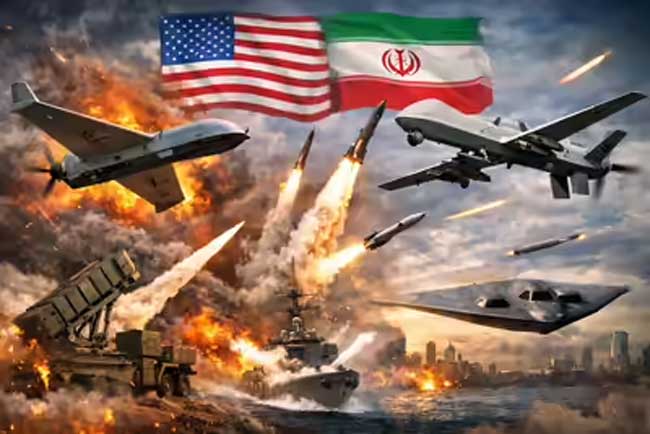
Amid rising tensions in the Middle East, a crucial question is increasingly dominating global strategic discussions: why does Iran appear more inclined to prolong its confrontation with the United States and Israel rather than bring it to a swift conclusion? For many international analysts, the answer lies in Tehran’s calculated geopolitical strategy—one that is less about winning a decisive war and more about gradually exhausting its adversaries.
At first glance, extending a conflict may appear risky for a country like Iran. However, a deeper strategic assessment suggests that Tehran is playing a long-term geopolitical game. Iran is well aware that in terms of conventional military power, technological capability, and global alliances, the United States and Israel possess a significant advantage. In such circumstances, a direct and decisive military confrontation would likely not favor Tehran. Instead, Iran appears to be transforming the conflict into a prolonged strategic contest where time itself becomes a weapon.
Experts often describe this approach as a “war of attrition.” In such a scenario, the objective is not immediate victory on the battlefield but the gradual erosion of the opponent’s political will, financial resources, and strategic patience. A prolonged conflict forces the United States and Israel to sustain high military expenditures, maintain extended deployments, and deal with growing domestic political pressures. Over time, the cumulative burden of these factors can create strategic vulnerabilities that Iran may seek to exploit.


Another key dimension of Iran’s strategy lies in expanding the geographical scope of the conflict. The Middle East is a region marked by complex alliances and proxy networks, and over the years Iran has developed influence through various regional actors. By ensuring that tensions are not confined to a single front, Tehran can compel its adversaries to divide their attention and resources across multiple theatres. This multi-front dynamic significantly increases the strategic complexity and cost of maintaining military dominance.
Energy geopolitics also plays a central role in this equation. The Middle East remains one of the most critical hubs of global energy supply, and instability in the region immediately reverberates through international oil markets. Fluctuations in oil prices can have far-reaching consequences, affecting inflation, financial stability, and economic growth in many Western economies. Analysts believe that Iran understands this geopolitical reality well and recognizes that heightened regional tension can indirectly place pressure on global powers through economic channels.
Domestic political considerations further shape Tehran’s strategic posture. Iran has faced years of economic sanctions and international pressure, which have significantly impacted its economy and internal political environment. In such conditions, an external security threat can sometimes reinforce national unity. When a nation perceives itself to be under external pressure, public attention often shifts away from internal challenges toward issues of sovereignty, resistance, and national pride. This dynamic can strengthen the government’s domestic legitimacy during periods of confrontation.
However, the consequences of a prolonged confrontation extend far beyond Iran, the United States, or Israel. A sustained escalation could destabilize the entire Middle East, disrupt global energy supplies, and complicate international diplomatic efforts. For this reason, the international community continues to closely monitor developments in the region while emphasizing the urgent need for diplomatic mechanisms to reduce tensions.
Ultimately, Iran’s strategy appears to be rooted not in the pursuit of a swift military victory but in a long-term recalibration of power dynamics. By stretching the conflict over time, Tehran seeks to create conditions where economic strain, political fatigue, and strategic overextension gradually weigh on its adversaries. In the complex geopolitical chessboard of the Middle East, this long-game approach reflects a belief that endurance and patience can sometimes prove as powerful as military strength itself.