

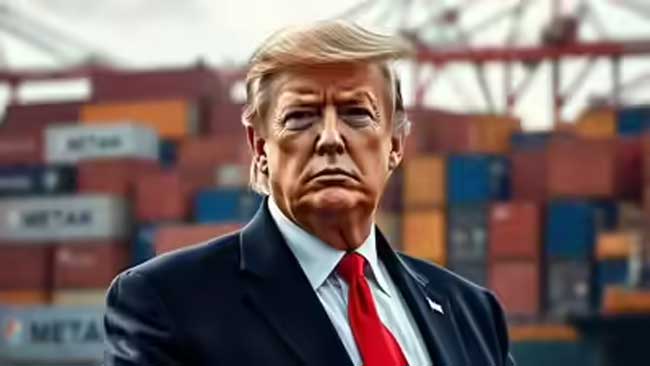
The U.S. Supreme Court on Friday delivered a landmark ruling, striking down the large-scale tariffs imposed by former President Donald Trump. In a 6-3 majority decision, Chief Justice John Roberts said Trump had exceeded the limits of his authority, making it clear that the President does not have the power to impose tariffs under a state of economic emergency without congressional approval.
Presidential Powers and the 1977 Law
Trump had relied on the International Emergency Economic Powers Act (IEEPA) of 1977 to levy tariffs without Congress’s consent. These included tariffs of up to 50% on countries including India, later reduced to 18%. The Supreme Court emphasized that under the U.S. Constitution, the power to levy taxes and tariffs belongs to Congress, not the President. Chief Justice Roberts noted that Trump’s decisions appeared driven more by personal vendetta and hostility rather than strengthening trade policy.
What About the Collected Tariffs?
The ruling raises questions about whether the collected tariffs will be refunded. If so, the U.S. government could have to return as much as $175 billion. Trump has defended his tariffs, saying they were in the national interest, and claimed that without them, the world would have mocked America. The Supreme Court did not specify whether the collected tariffs would be returned.


Details of the Court’s Decision
Liberal justices Ketanji Brown Jackson, Elena Kagan, and Sonia Sotomayor, along with conservative justices Amy Coney Barrett, Neil Gorsuch, and Chief Justice John Roberts, supported overturning the tariffs. Justices Samuel Alito, Clarence Thomas, and Brett Kavanaugh dissented, favoring their continuation. Kavanaugh warned that refunding the tariffs could be extremely complex, potentially requiring the government to return billions of dollars.
Political and Economic Impact
Trump had made tariffs a central part of his economic agenda ahead of the midterm elections, even calling the term one of his favorites. He claimed that tariffs would bring factories back to the U.S. and create jobs, and warned that removing them could push America into a deep recession.
The Supreme Court’s decision is expected to prolong political and economic uncertainty in international trade. Republican strategist Doug Heye noted that it was immediately clear the President would not be pleased, but Trump may still look for alternative ways to advance his trade agenda.
Former Vice President Mike Pence, who served under Trump, described the ruling as a victory for the American people. Democratic leaders also reacted promptly, with Congresswoman Suzan DelBene saying Trump is “not a king” and that his tariff regime was always unlawful.