

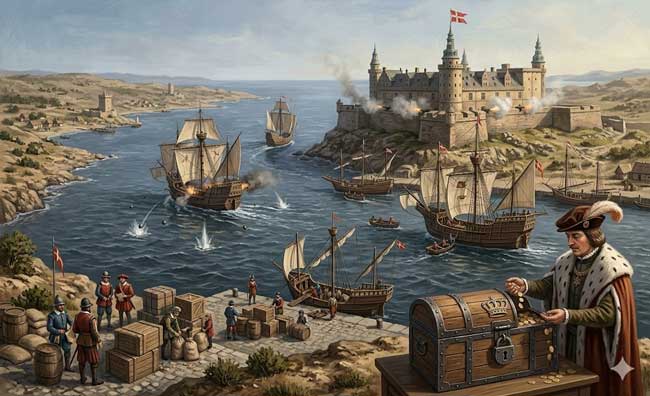
In 1429, King Eric of Pomerania began charging ships to pass through the Øresund, the narrow strait separating today’s Denmark and Sweden. Every vessel bound for the Baltic, whether stopping in Denmark or not, had to halt at Helsingør Castle and pay the king. Refusal was met with cannon fire. By the sixteenth century, the “Sound Dues” accounted for up to two-thirds of Danish royal revenue. The toll, formalized in 1567 as 1–2% of cargo value, tripled receipts and ran—almost uninterrupted—for 428 years. It took thirteen nations and 33.5 million rix-dollars, roughly twelve years of toll income, to abolish it under the Copenhagen Convention of 1857. Whether King Eric’s successors considered this a satisfactory settlement remains unknown.
Today, the Strait of Hormuz is rewriting that history.
Iran’s Tollbooth in Action
Since February 28, following US and Israeli strikes, the Islamic Revolutionary Guard Corps (IRGC) has meticulously built its modern tollbooth. Ships must submit full documentation—IMO number, crew list, cargo manifest, destination, and AIS data—to an IRGC-linked intermediary. Nations are ranked on a five-tier friendliness scale. India, Pakistan, China, and Iraq are currently in Iran’s “green zone.” Vessels that pass receive a clearance code and routing instructions. Approaching the narrow channel north of Larak Island, off Bandar Abbas, ships broadcast their code via VHF radio and are escorted by IRGC patrols.


The toll: roughly USD 1 per barrel of oil. A Very Large Crude Carrier with two million barrels pays USD 2 million per transit, in Chinese yuan or stablecoins. Iran’s parliament recently moved to formalize this scheme in rials.
Shipping data tells the story of disruption: pre-war, 135 commercial vessels crossed daily, carrying 20 million barrels of oil and LNG—one-fifth of global supply. By late March, only 24 vessels made the crossing, a 96% drop. Since March 13, all transits have used the Larak detour; the main shipping lane saw no traffic from March 16 until today’s ceasefire.
What Iran Could Have Earned
At pre-war traffic levels, roughly ten VLCCs crossed daily. At USD 2 million per vessel, that’s USD 20 million per day, USD 800 million per month from oil alone—comparable to Egypt’s annual Suez Canal revenue. Analysts estimate a full toll on all vessels could yield USD 50–73 billion annually for the IRGC, effectively doubling Iran’s oil revenue. Each USD 2 million transit adds about USD 2 to the global oil price, already near USD 100 per barrel. Iran’s toll has the potential to become a structural premium on global energy costs.
Legal Thin Ice
International law is clear: the UN Convention on the Law of the Sea guarantees free, continuous, unimpeded passage through international straits. Article 26 forbids fees solely for passage. Iran, which has not ratified UNCLOS, relies on a narrow technical argument. But customary international law, as affirmed by the International Court of Justice in the 1949 Corfu Channel case, guarantees free transit to all states regardless of treaty ratification. Iranian references to the Suez and Panama Canals fail: both are artificial waterways with explicit toll regimes. Hormuz is a natural strait with no treaty authorization.
Yet law is enforced by those with navies and political will. The United States, despite having destroyed 130 Iranian vessels, could not guarantee shipping escorts. The EU ruled out intervention. China secured bilateral arrangements for two Cosco ships but has no incentive to push a multilateral toll-free regime. India, reliant on the strait for 45% of crude imports, 90% of LPG, and half of LNG, used diplomacy and warship escorts to secure passage—but still faces skyrocketing energy costs and a falling rupee.
Ceasefire: A Temporary Truce, Not Freedom
On April 8, President Trump announced a two-week ceasefire contingent on Iran reopening the strait. Iranian Foreign Minister Abbas Araghchi confirmed “safe passage through the Strait of Hormuz…via coordination with Iran’s Armed Forces and with due consideration of technical limitations.” Iran’s Supreme National Security Council emphasized “regulated passage…thereby conferring upon Iran a unique economic and geopolitical standing.” Brent crude fell below USD 96; markets surged.
The nuance is critical: Iran has not fully reopened Hormuz. Passage will be controlled by the Iranian Armed Forces. The US has acknowledged this formulation. Negotiations in Islamabad will decide whether Iran abandons tolls or maintains its chokehold.
Iran’s Strategic Realization
Beyond the Persian Gulf, the stakes are global. Three-quarters of global maritime trade flows through thirteen chokepoints. Iran’s IRGC recognizes the leverage a natural strait can confer: Hormuz may become a permanent tollbooth.
In 1857, thirteen nations collectively bought out Denmark to ensure Øresund remained free. Today, the world faces a test: will Hormuz remain a free international passage, or has the age-old toll simply moved east? Iran’s 10-point plan values its position at USD 2 million per vessel in perpetuity, roughly USD 9 billion annually at pre-war volumes. King Eric of Pomerania would have understood immediately: natural chokepoints are power.
The US-Iran talks beginning Friday will determine whether free navigation survives—or whether the toll at Helsingør has simply been relocated to Bandar Abbas.