

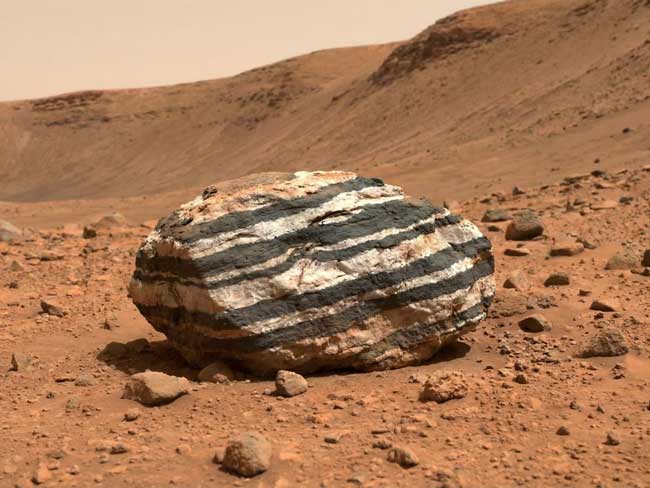
Mars has once again presented scientists with a fascinating mystery. The Perseverance rover of the U.S. space agency NASA has captured and transmitted an image from the Red Planet that has drawn global attention. Amid the dusty red-orange soil and rocky terrain, a peculiar black-and-white striped stone has been spotted. Social media users have nicknamed it the “Zebra Rock.”
What Is the ‘Zebra Rock’?
Although relatively small—about 20 centimeters (around 8 inches) wide—the stone stands out because of its unusual appearance. NASA’s team has officially named it “Freya Castle.” The clearly visible black and white stripes sharply contrast with the surrounding reddish-brown Martian rocks, making it visually striking even from a distance.
Where Was It Found?
The unusual rock was discovered in the region of Jezero Crater on Mars. Scientists believe this area was once home to an ancient lake billions of years ago. Currently, the Perseverance rover is climbing the crater’s elevated slopes, where it encountered the rock lying separately on the surface.


Researchers note that such a patterned rock has not previously been observed on Mars. While detailed chemical analysis is still pending, scientists have proposed two possible formation processes.
Possible Scientific Explanations
Igneous Process: When molten magma cools slowly beneath the surface, different minerals crystallize in layers. This can create striped patterns within the rock.
Metamorphic Process: Extreme heat and pressure can alter the structure of rocks over time. On Earth, similar processes sometimes produce zebra-like banding patterns.
Why Are Scientists So Intrigued?
What makes this discovery particularly compelling is that the rock does not match the surrounding terrain. It appears to be a loose fragment rather than part of the local bedrock. Scientists suspect it may have rolled down from higher elevations within the crater.
As the Perseverance rover continues its ascent, researchers hope it will locate the original source of this mysterious “Zebra Rock.” If found, it could offer valuable insights into Mars’ geological past, including evidence of volcanic activity and intense heat processes that shaped the planet billions of years ago.
Though small in size, the Zebra Rock may hold significant clues about the hidden history of the Red Planet.