

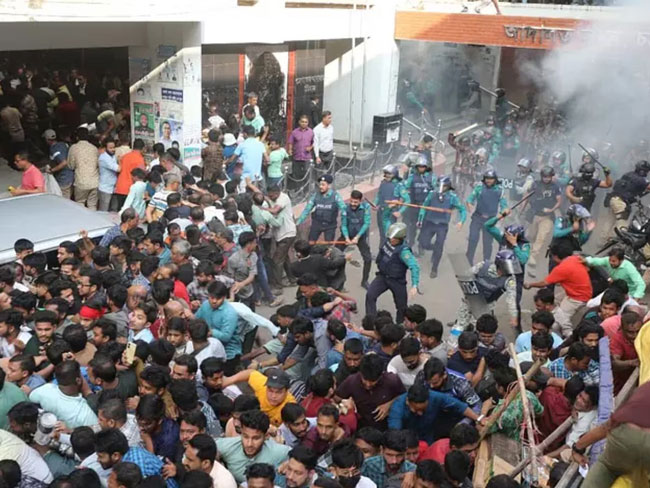
In July 2024, a student-led uprising in Bangladesh toppled Sheikh Hasina’s 15-year-long government, marking the beginning of a historic political transition in the country. However, according to a recent report by the BRAC Institute of Governance and Development (BIGD), “Rupture, Reform, and Reimagining Democracy: Navigating the Agony of Transition”, the uprising did not lead to deep structural changes. Instead, the political vacuum that followed created space for the rapid rise of Islamic politics.
Dr. Mirza M. Hasan, one of the report’s authors, explained, “Many expected that the uprising would bring major changes in the political system, party structures, and elite composition. We anticipated a new elite order and at least some establishment of the rule of law. But that did not happen. Instead, we saw disorder, weak interim governance, and mob-like situations that failed to advance the democratic aspirations of the people. In that sense, calling it a major change would be an exaggeration. There were only partial, limited shifts—more than just a change in leadership, but far from a complete transformation.”
Hasan further noted that the collapse of the repressive regime provided an opportunity for previously suppressed Islamic groups to gain prominence. “These groups capitalized on the moment, strengthening their grip on both political parties and civil society. We have also observed a significant ideological shift. For decades, mainstream political thought—represented by parties like the Awami League, BNP, and JP—was centrist-right. With the rise of political Islam, especially the Jamaat, there has been a major shift toward right-wing Islamic ideology. This ideological change is perhaps the most important outcome of the uprising.”


Dr. Hasan warned that the rise of political Islam would disproportionately affect women. “Women, in particular, along with minorities, will face the consequences. Right-wing forces may tolerate minorities as they are not seen as a major threat, but women will likely face stricter controls and restrictions. Unless a future political party—be it BNP or Jamaat—manages this carefully, the impact could be severe. This marks the first time Bangladesh will witness some form of formal and informal Islamic governance, which will create challenges for women’s rights and freedoms.”
The story of the uprising highlights the gap between the aspiration for political change and the reality on the ground. While there was a change in power, structural reforms and democratic stability remain a work in progress.