
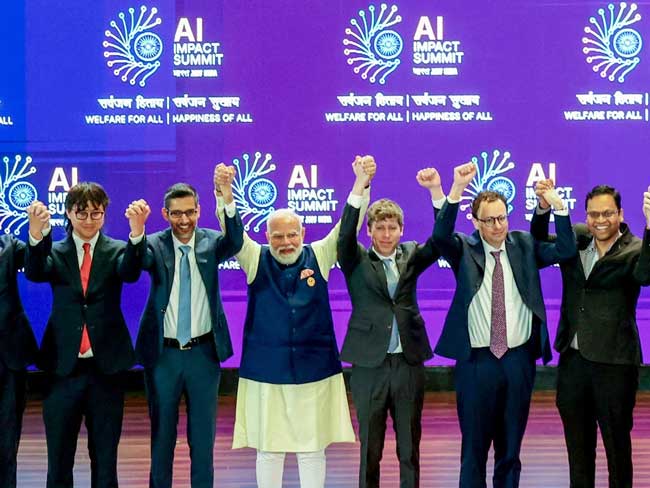
For decades, India has often watched the world’s technological revolutions as a spectator. But in 2026, it proved that it can play a decisive role on the global AI stage. The “New Delhi Declaration on AI Impact”, signed by 88 countries, is not just a document—it is a symbol of India’s vision, determination, and leadership in technology.
The declaration was adopted at the India AI Impact Summit 2026 in New Delhi, with major powers including the United States, China, France, the United Kingdom, and Australia lending their support. At its core, the declaration emphasizes that artificial intelligence should not remain the domain of a few developed nations or large corporations. Instead, it should be developed for everyone, in the interest of everyone, and with the participation of all.
The Human Face of AI
What sets India’s approach apart is its focus on human-centric, inclusive AI. The declaration highlights that the true value of AI lies in its societal benefit—whether in education, healthcare, or employment, AI must be accessible and equitable.


Experts describe this as inspired by the principle of “Sarvajan Hitay, Sarvajan Sukhay”—for the welfare and well-being of all. The declaration underscores that technology should foster social and economic development, not just innovation.
Key Pillars of the Declaration
The New Delhi Declaration includes several foundational initiatives that distinguish it from other international frameworks:
- Democratic Diffusion Charter: Ensuring access to AI resources and innovation across countries and institutions.
- Global AI Impact Commons: Sharing successful AI applications and enabling their replication globally.
- Trusted AI Commons: Establishing frameworks for the safety, reliability, and best practices of AI systems.
- International Network of AI for Science Institutions: Promoting scientific research through AI and strengthening institutional networks.
- Social Empowerment Platform: Leveraging AI to provide equal opportunities, learning, and skills development across all sections of society.
These initiatives signal that India is not just a consumer of technology but increasingly a global policymaker shaping the AI agenda.
India’s Global Role
The declaration represents a showcase of India’s diplomacy and technological foresight. Experts believe it not only validates India’s AI policy internationally, but also demonstrates that India can bring balance and inclusivity to global AI governance.
India is no longer a passive participant; it is establishing itself at the center of global AI decisions and strategy. Its influence is expected to shape education, employment, innovation, and social development in the coming years.
Challenges and Opportunities
While the declaration is non-binding, its global acceptance sends a clear message: AI development cannot remain confined to a few nations. The real challenge now lies in implementation, especially in ensuring equitable access and skill-building in developing countries.
Yet, these challenges also present an opportunity for India. If implemented effectively, India could become a global leader in AI innovation, policy, and international collaboration.
Conclusion:-The New Delhi Declaration is not just a technical framework; it is a manifestation of India’s ambition and vision. It proves that AI is not merely a game of machines—it is a chance to serve humanity, and India has successfully positioned itself as a key player shaping that future on the global stage.