
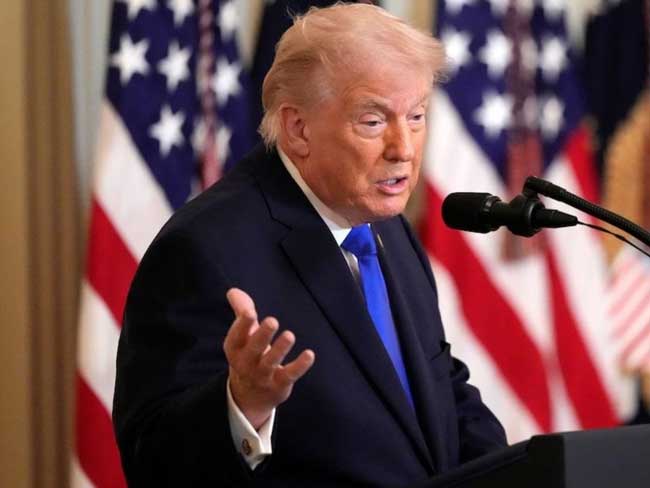
Washington: US President Donald Trump has once again reiterated his controversial claim that he helped prevent a full-scale conflict between India and Pakistan by using the threat of steep trade tariffs, including what he described as “devastating economic sanctions”.
In an interview with CNBC’s Joe Kernen, Trump asserted that his trade strategy played a decisive role in ending multiple global conflicts during his presidency.
“I stopped eight wars because of tariffs – India, Pakistan. I stopped eight wars. Everybody acknowledges it. And five of the eight were stopped because of tariffs,” Trump said.

Recounting the period of heightened India-Pakistan tensions, Trump claimed he directly warned both countries of severe economic consequences. “I said, if you keep fighting, I’m going to put a 200 per cent tariff on your country. Said the same thing to the other. I did it with India and with Pakistan,” he stated.
He further alleged that the two nuclear-armed neighbours were on the brink of a wider war. “Eleven planes were shot down. They were going to war, and they are nuclear nations – strong nuclear nations,” he said.
Trump also claimed that Pakistan Prime Minister Shehbaz Sharif had praised his intervention, saying the US President “saved at least 30 million lives” by preventing escalation.
The remarks come amid renewed scrutiny of Trump’s trade policies, after the US Supreme Court ruled in February that his administration had exceeded its authority in imposing broad tariffs under the International Emergency Economic Powers Act of 1977.
The backdrop to Trump’s comments includes the April 2024 Pahalgam terror attack that killed 26 people, followed by India’s precision strikes on cross-border terrorist infrastructure under ‘Operation Sindoor’.
However, India has consistently rejected any suggestion of third-party mediation in its dealings with Pakistan. New Delhi maintains that the ceasefire and de-escalation were achieved strictly through direct communication between the Directors General of Military Operations (DGMOs) of the two countries, reiterating that all outstanding issues with Pakistan remain strictly bilateral.