
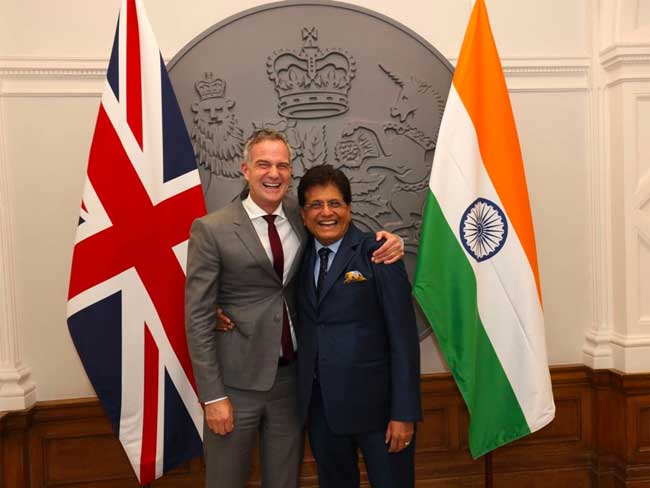
New Delhi: India and the United Kingdom are set to deepen their economic engagement with the implementation of two key agreements—the Comprehensive Economic and Trade Agreement (CETA) and the Double Contribution Convention (DCC)—from July 15, 2026. The agreements are expected to significantly enhance investment flows, innovation, and overall economic growth between the two countries.
Union Commerce and Industry Minister Piyush Goyal shared details of his meeting with UK Secretary of State for Business and Trade, Peter Kyle, on social media platform X. The meeting was held in London, where both sides discussed new avenues to strengthen bilateral economic and trade cooperation.
Describing the engagement as productive, Goyal said that discussions focused on exploring opportunities to further deepen India–UK economic ties.

The CETA aims to expand bilateral trade, improve market access for goods and services, and strengthen cooperation across multiple sectors. It is expected to create a more open and predictable trade environment between the two economies.
The Double Contribution Convention (DCC) is designed to streamline social security arrangements for employees working between India and the UK. It ensures that employees and employers are not required to make social security contributions in both countries simultaneously, thereby avoiding double contributions.
Under the framework, employees on temporary assignments abroad can continue contributing to their home country’s social security system, ensuring continuity of benefits and records without disruption.
The DCC is part of a broader Social Security Agreement framework that coordinates contribution rules between two countries. While it does not alter eligibility for benefits such as pensions, it simplifies compliance for international workers and employers.
Once implemented, the agreement will eliminate the issue of double contributions and extend the exemption period for detached workers from 52 weeks to up to 60 months, providing significant relief for companies and employees engaged in cross-border assignments.