
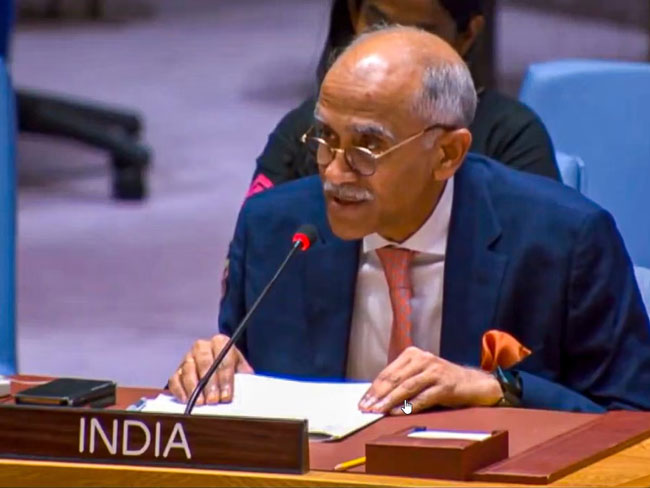
New York : India’s Permanent Representative to the United Nations, Ambassador Harish Parvathaneni, while addressing the UN debate on “Peacebuilding and Sustaining Peace,” emphasized that long-term success in conflict-affected regions depends on prioritising national ownership and building strong institutional resilience.
According to the Permanent Mission of India to the UN, shared on social media platform X, Ambassador Parvathaneni participated in the Peacebuilding Commission (PBC) Annual Session held during the inaugural “Peacebuilding Week,” marking 20 years of the UN’s peacebuilding architecture. He stated that peacebuilding must be demand-driven and anchored in national ownership, while partnerships should be based on trust, dignity, and equality, moving beyond a donor–recipient framework.
He further noted that the true measure of peacebuilding success lies in strengthening national capacity and institutional resilience in countries emerging from conflict. Reaffirming India’s commitment, he highlighted India’s continued support for the Women, Peace and Security agenda in peacebuilding efforts.


During the General Assembly debate, the Ambassador appreciated the progress made during the 19th Session of the Peacebuilding Commission, including the successful completion of the fourth review of the peacebuilding architecture and the presentation of the first national peacebuilding strategy. He also welcomed the UN General Assembly’s approval of a $50 million assessed contribution to the Peacebuilding Fund.
However, he expressed concern over the financial health of UN peacebuilding efforts. Citing the Secretary-General’s report, he noted a continuous decline in voluntary contributions over the past three years, along with liquidity constraints affecting assessed contributions, which have collectively restricted available funding.
He stressed that in order to maximize impact under limited resources, funding priorities must focus on post-conflict settings and called for further progress in the upcoming strategy of the Peacebuilding Fund.
Ambassador Parvathaneni also highlighted that effective peacebuilding must move beyond the traditional donor–recipient model and instead be designed in line with the priorities and needs defined by national governments, with the international community playing a supportive role through financial and technical assistance.
He reiterated that institutional resilience and national capacity-building must remain the cornerstone of all peacebuilding efforts, as these are essential for sustainable peace.
In his concluding remarks, he reaffirmed India’s commitment to the Women, Peace and Security agenda, noting that the recognition of Major Abhilasha Barak as the 2025 Military Gender Advocate of the Year reflects India’s contribution in this field. He added that India remains ready to work with global partners and share its nation-building experience to advance sustainable peace worldwide.
The first UN Peacebuilding Week (June 22–26) serves as a platform to advance dialogue, exchange experiences, and strengthen global cooperation in peacebuilding. This inaugural edition also marks the 20th anniversary of the UN Peacebuilding Commission and the Peacebuilding Fund, both established in 2006.