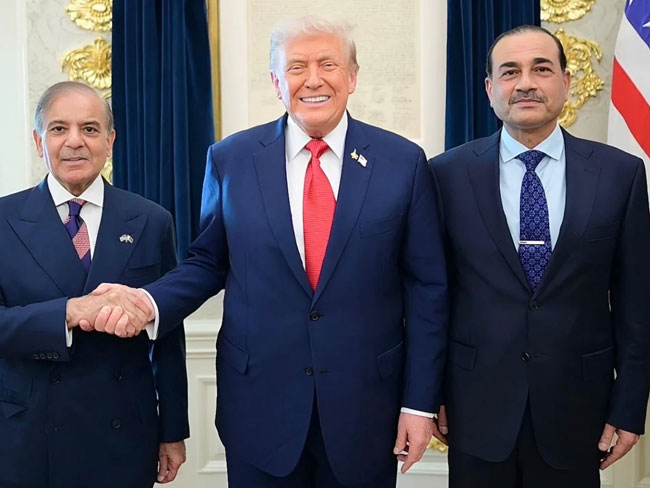
The international community’s continued engagement with Pakistan, despite its chronic political instability, economic fragility, and recurring security crises, is not an act of trust. It is an act of compulsion. Beneath the diplomatic language of cooperation and assistance lies a harder truth: Pakistan is not being accommodated because it is reliable, but because it is unavoidable.
This is the central contradiction that defines global policy toward Islamabad. A state frequently described in strategic assessments as unstable and high-risk continues to receive financial lifelines, diplomatic attention, and security engagement from the very powers that publicly flag its systemic weaknesses.
Geography That Cannot Be Ignored
Pakistan’s greatest asset is not its governance—it is its geography. Wedged between South Asia, West Asia, and Central Asia, and sharing borders with India, Iran, Afghanistan, and China, Pakistan sits at a critical intersection of global strategic interests.
This positioning ensures that no major power can afford to disengage. For the United States, Pakistan remains a residual security stakeholder in Afghanistan and a counterterrorism contact point. For China, it is a key corridor state through the China–Pakistan Economic Corridor, providing vital access to the Arabian Sea. For Gulf states and international energy routes, Pakistan is part of a broader regional stability equation.
The result is simple: Pakistan’s geography keeps it relevant even when its internal conditions suggest otherwise.
Instability as a Managed Risk
Perhaps the most uncomfortable reality in global diplomacy is that Pakistan’s instability is not treated as a reason for isolation—it is treated as a condition to be managed.
The international system, particularly Western-led financial and diplomatic institutions, operates on the assumption that collapse is more dangerous than dysfunction. A failing Pakistan is viewed as a nuclear-armed risk multiplier, capable of triggering refugee flows, militant spillovers, and regional escalation.
So instead of disengagement, the world chooses containment through engagement. Instead of pressure alone, it relies on calibrated support. This is not confidence in Pakistan’s governance. It is fear of its failure.
The Financial Lifeline Cycle
Pakistan’s repeated recourse to international financial assistance, particularly from the International Monetary Fund, reflects a structural dependency rather than cyclical distress. Each bailout is justified not by reform credibility but by crisis prevention.
The logic is blunt: a defaulting Pakistan would not remain a domestic economic issue for long. It would quickly evolve into a regional security problem. This transforms financial institutions into instruments of stability management rather than economic reform enforcement.
The consequence is a recurring cycle—crisis, bailout, partial stabilization, relapse—without structural transformation.
Nuclear Reality: The Ultimate Constraint
No analysis of Pakistan’s global relevance is complete without acknowledging its nuclear capability. It is this factor that fundamentally alters the international cost-benefit calculation.
A nuclear-armed unstable state is treated differently from a non-nuclear unstable state. The risks are exponentially higher, and the consequences of disengagement far more severe. The fear of escalation, miscalculation, or loss of centralized control ensures that Pakistan remains permanently within the radar of global security architecture.
In practical terms, nuclear capability does not guarantee strength—it guarantees attention.
India’s Persistent Strategic Frustration
For India, this global approach appears deeply inconsistent. New Delhi has long argued that Pakistan’s alleged use of cross-border militancy as a policy tool should have invited greater international accountability and sustained pressure.
Yet the global response has largely been one of balance rather than alignment—engagement without endorsement, concern without isolation. The result is a diplomatic equilibrium that often dilutes India’s strategic expectations while preserving Pakistan’s international space.
This imbalance is not accidental. It is the product of competing global priorities that extend far beyond South Asia.
Conclusion: A State Too Risky to Ignore, Too Weak to Trust
Pakistan’s position in the international system is defined by contradiction. It is simultaneously indispensable and unreliable, strategically central and structurally fragile, diplomatically engaged and politically unstable.
The world does not engage Pakistan because it believes in its stability. It engages Pakistan because it cannot afford to ignore its instability.
And that is the uncomfortable truth at the heart of global diplomacy: Pakistan is not accommodated out of choice, but out of necessity—and necessity rarely produces clarity, only compromise.