
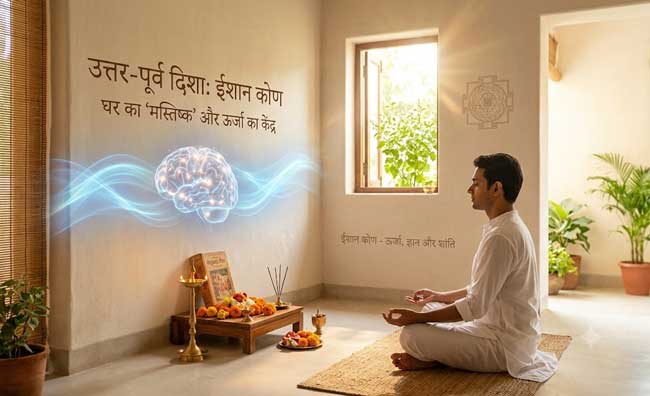
In Vastu Shastra, directions are not seen merely as physical orientations but as living channels of energy. Among  them, the northeast direction—known as the Ishan Kon—is considered the most subtle, pure, and powerful. Traditional wisdom even refers to it as the “brain” of the house. But why is a direction compared to the human brain?
The answer lies not only in belief but also in the relationship between nature, space, and human consciousness.
The Northeast: Where Light and Consciousness Begin
The northeast is the part of a house that first receives the morning sunlight. These early rays are not just light—they symbolize awakening energy that gently activates the entire space.


Ancient architectural traditions therefore viewed this direction not as a boundary, but as the “source point of energy flow” within a home.
Spiritually, it is associated with clarity, wisdom, and mental peace. Just as the brain guides the body, this direction is believed to influence and regulate the overall energy of the home.
The Deep Connection with the Water Element
In Vastu principles, the northeast is associated with the water element. Water is calm, pure, and naturally flowing.
Similarly, this direction is believed to maintain emotional balance within the household. When this area is open, clean, and uncluttered, the home feels lighter, calmer, and more stable.
However, if this zone is blocked, dark, or burdened with heavy objects, it is believed to disrupt the natural flow of energy.
Why It Is Called the “Brain” of the House
If a house is imagined as a living organism, each direction represents a functional organ:
- Southwest represents stability
- South represents strength and protection
- West represents experience and results
- And the northeast acts as the center of thought, clarity, and energy balance
This is why it is referred to as the “brain” of the house.
Just like the human brain coordinates all bodily functions, the northeast is believed to subtly influence mental peace, decision-making, and emotional harmony within the home.
A Preferred Space for Meditation and Spiritual Practice
Traditionally, the northeast is considered the most suitable place for prayer rooms, meditation spaces, and spiritual practice.
This is not only a religious belief but also a psychological observation. A calm and uncluttered northeast environment is believed to enhance concentration and inner stability.
When a person meditates facing this direction, distractions are believed to reduce, allowing greater mental clarity.
Common Mistakes That Disturb Energy Balance
Many households unintentionally disturb the harmony of this direction. Common issues include:
- Placing heavy furniture in the northeast
- Keeping the area dark or closed off
- Using it as storage or dumping space
- Improper placement of water tanks
- Over-decorating and cluttering the zone
Such conditions are traditionally believed to obstruct energy flow.
Simple Adjustments That Can Improve the Atmosphere
Even small changes can make a noticeable difference:
- Keep the area clean and open
- Allow natural light to enter
- Use light and soothing colors
- Create a calm meditation or sitting space
- Maintain proper placement of water-related elements
These adjustments are believed to bring lightness and positivity into the entire home environment.
The Invisible Link Between Mind and Space
Vastu is not only about physical directions; it reflects the subtle connection between human psychology and environment. When the mind is disturbed, it affects the space around it—and when the space is unbalanced, the mind feels heavier.
The northeast direction is considered the focal point of this balance, where clarity of thought and emotional stability come together.
Understanding the northeast direction is not merely about architecture—it is about recognizing the subtle harmony between nature, energy, and human life. It represents more than a physical corner of the house; it forms an invisible foundation upon which the atmosphere of the entire home rests.