
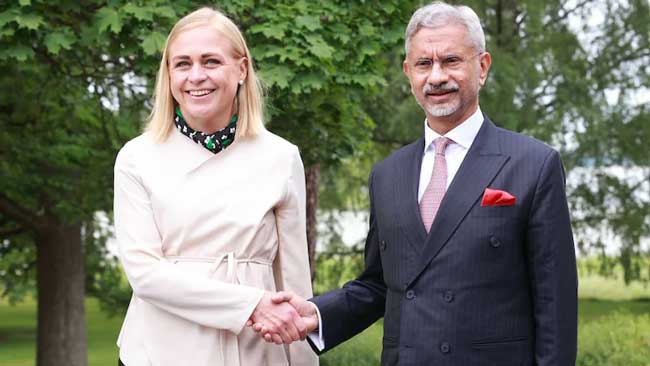
Desk : Amid recurring criticism from some Western nations over India’s purchase of Russian crude oil, Finland has come out in support of New Delhi’s position. Finnish Foreign Minister Elina Valtonen stated that India had complied with the Western-imposed price cap on Russian oil purchases and that such compliance was consistent with the original objective of the policy.
Speaking during the Kultaranta Talks in Finland alongside India’s External Affairs Minister Dr. S. Jaishankar, Valtonen said that the purpose of the price cap mechanism was not to prevent countries from buying Russian oil altogether. Instead, she noted, the policy was designed to maintain global energy supplies while limiting Russia’s revenue from oil exports. In that context, India’s purchases were made within the framework established by Western countries.
Defending India’s energy policy, Dr. Jaishankar emphasized that New Delhi’s decisions are guided by national interest and energy security rather than political considerations. He pointed out that after sanctions were imposed on Russia in 2022, global energy markets underwent significant changes. European countries increased their purchases of Middle Eastern oil, reducing the availability of traditional supplies for countries such as India. As a result, Russian crude emerged as an important alternative source for India’s growing energy needs.


Jaishankar further stated that India’s foremost responsibility is to ensure affordable and reliable energy supplies for its population of over 1.4 billion people. He also recalled that, during the early phase of the sanctions regime, the United States had encouraged countries to continue purchasing Russian oil within the price-cap framework in order to prevent disruptions in global energy markets.
Responding to criticism from some European quarters, the Indian foreign minister remarked that several European nations had for years supplied weapons that were later used against India. He argued that India had never taken actions that threatened Europe’s security and that its energy decisions should therefore be viewed through the lens of legitimate national interests.
Jaishankar also underlined India’s balanced approach to energy partnerships. Russia currently remains India’s largest supplier of crude oil, while the United States is among its key partners in the natural gas sector. He added that India’s relations with Gulf countries extend far beyond energy and encompass strategic, economic, and diplomatic cooperation.
Valtonen’s remarks come at a time when debates surrounding Russian energy exports and the ongoing Russia–Ukraine conflict continue to shape international discussions. Observers believe that Finland’s support strengthens India’s argument that its purchases of Russian oil have remained within internationally accepted rules and the Western price-cap mechanism.