
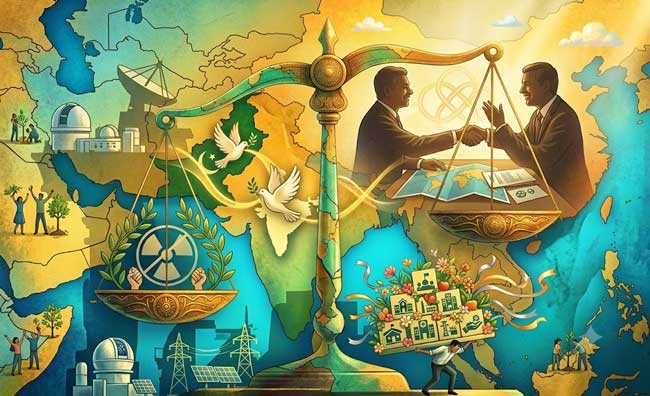
In global geopolitics, nuclear weapons are not merely instruments of military strength; they are also powerful symbols of political intent and strategic messaging. According to a recent report by the Stockholm International Peace Research Institute (SIPRI), India’s nuclear arsenal has reportedly increased from around 180 to approximately 190 warheads. While this numerical change may appear modest, it carries deeper strategic implications in an increasingly volatile international security environment.
South Asia remains one of the most sensitive nuclear regions in the world, shaped by the triangular strategic equation between India, Pakistan, and China. In such a setting, any change in nuclear capability is interpreted not in isolation, but as part of a broader regional and global power narrative.
India’s nuclear doctrine has traditionally been guided by the principles of “No First Use” and “credible minimum deterrence.” This policy framework has positioned India as a responsible nuclear power that seeks stability rather than escalation. However, evolving security dynamics, persistent border tensions, and the rapid modernization of neighboring military capabilities have complicated this strategic equilibrium.

China’s continued expansion and modernization of its nuclear arsenal, along with Pakistan’s efforts to strengthen its strategic capabilities, have contributed to a regional environment defined by uncertainty and mutual distrust. In this context, India’s incremental increase in nuclear stockpile is widely interpreted as an attempt to maintain credible deterrence rather than to pursue offensive escalation.
From a strategic theory perspective, nuclear weapons are not intended for battlefield use but for deterrence—preventing war through the assurance of unacceptable retaliation. India’s posture, therefore, can be seen as reinforcing this deterrence-based framework in response to shifting regional realities.
However, this development also raises a broader and more uncomfortable question: Is the world gradually entering a renewed phase of nuclear expansion? The post–Cold War expectation of gradual disarmament appears increasingly distant as major powers continue to modernize and, in some cases, expand their nuclear arsenals.
The SIPRI findings highlight a paradox in global security architecture—while nuclear non-proliferation remains an official global objective, the practical behavior of several nuclear-armed states suggests sustained reliance on these weapons for strategic stability. This contradiction weakens the credibility of disarmament frameworks and raises concerns about a slow but steady arms race.
For India, the challenge lies in balancing multiple strategic objectives. On one hand, it must ensure national security in a complex and unpredictable neighborhood. On the other, it must maintain its international image as a responsible nuclear power committed to restraint and strategic stability.
There is also an important domestic dimension to this debate. As a developing economy, India must continuously evaluate the opportunity costs of defense spending in relation to pressing social priorities such as healthcare, education, and infrastructure development. The expansion of strategic capabilities, while necessary for security, inevitably raises questions about long-term resource allocation.
At the global level, the relevance of nuclear disarmament treaties and non-proliferation regimes is increasingly being questioned. When major powers continue to invest in modernization of their arsenals, expectations of restraint from emerging powers appear uneven and strategically asymmetrical.
South Asia’s security environment is further complicated by historical conflicts and deep-rooted strategic mistrust. In such a context, even incremental changes in military capability are often interpreted as signals of intent, thereby influencing the strategic calculations of neighboring states.
Ultimately, the increase in nuclear stockpiles reflects a broader reality of contemporary international politics: peace is not sustained solely through declarations, but through carefully maintained balances of power. Yet, such balances are inherently fragile. A minor miscalculation or escalation in perception can have consequences far beyond the intended scope.
What is required now is a parallel emphasis on diplomacy, confidence-building measures, and sustained dialogue, alongside deterrence. Military balance alone cannot guarantee lasting peace unless it is supported by political trust and strategic communication among nuclear-armed states.