
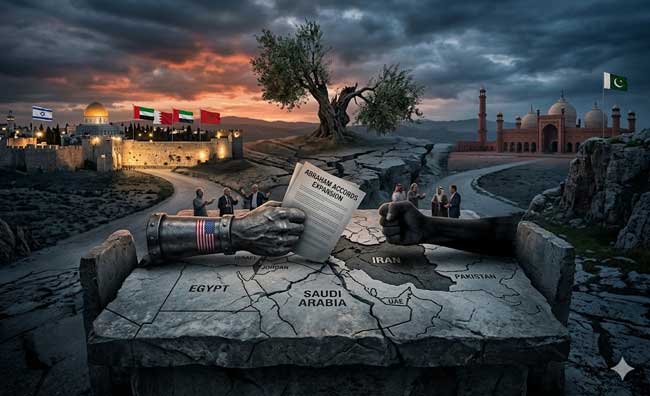
The debate over Middle Eastern peace frameworks has entered a renewed and contentious phase, as discussions around regional security, diplomatic normalization, and alliance-building intensify. At the center of this evolving discourse are reports and political signals suggesting that future negotiations involving Iran could be linked to broader regional realignments—particularly the expansion of normalization with Israel under the existing Abraham Accords framework.
The remarks attributed to former U.S. President डोनाल्ड ट्रंप have reignited global attention on how the United States may shape or influence the next phase of Middle Eastern diplomacy. According to these accounts, any durable settlement involving Iran would require a wider regional alignment that strengthens cooperation with Israel and expands the scope of the अब्राहम समझौता beyond its current participants.
Originally brokered in 2020 under U.S. mediation, the Abraham Accords marked a significant departure from decades of Arab-Israeli hostility, leading to formal diplomatic relations between Israel and countries including the United Arab Emirates, Bahrain, Morocco, and Sudan. Since then, the framework has been viewed both as a diplomatic breakthrough and as a strategic alignment aimed at reshaping regional security dynamics, particularly in relation to Iran.


The current discussion about expanding this framework to include additional Muslim-majority countries—including Saudi Arabia, Qatar, Türkiye, Egypt, Jordan, and Pakistan—has introduced new geopolitical sensitivities. While proponents argue that broader normalization could stabilize the region and unlock economic integration, critics warn that such pressure-based diplomacy risks deepening existing fault lines.
Among the most firm and consistent voices in this debate is पाकिस्तान. Islamabad has long maintained that recognition of Israel is contingent upon the establishment of a sovereign Palestinian state based on pre-1967 borders, with East Jerusalem as its capital. This position continues to define Pakistan’s diplomatic posture and remains deeply embedded in its domestic political and ideological framework.
Senior Pakistani officials, including Defence Minister ख्वाजा आसिफ and Foreign Minister इशाक डार, have reiterated that Pakistan cannot alter its stance under external pressure. Their statements reflect not only foreign policy continuity but also the constraints imposed by domestic public opinion and influential political-religious constituencies.
The broader geopolitical question, however, extends beyond Pakistan or any single state. It concerns the nature of emerging regional order in the Middle East. Is the region moving toward a cooperative diplomatic architecture based on mutual recognition and gradual normalization, or toward a bloc-driven system where states are expected to align politically before peace negotiations can proceed?
The Abraham Accords have already highlighted a growing divergence within the Muslim and Arab worlds. Some states have chosen pragmatic engagement with Israel, prioritizing trade, security cooperation, and technological exchange. Others continue to place the unresolved Palestinian question at the center of their foreign policy, viewing normalization without a political settlement as premature.
This divide raises a critical challenge: accelerated normalization efforts, especially if tied to broader strategic negotiations involving Iran, could risk reinforcing geopolitical fragmentation rather than reducing it. Instead of building a unified peace architecture, the region may drift toward competing security blocs defined by opposing alliances and threat perceptions.
Another dimension of this evolving landscape is the potential reconfiguration of Iran’s role. Traditionally viewed as a regional rival by several Gulf and Western-aligned states, Iran’s hypothetical inclusion in any future diplomatic arrangement would represent a significant shift in strategic thinking. However, such a scenario would require reconciling deep-seated security concerns with the broader objective of long-term regional stability.
Beyond high politics, there are also practical and legal implications that underscore the complexity of normalization. In Pakistan’s case, for example, the national passport explicitly restricts its validity with respect to Israel, reflecting a long-standing political position. Any formal diplomatic shift would therefore require not only foreign policy recalibration but also legal and institutional reforms—moves that would inevitably trigger intense domestic debate.
Ultimately, the current moment reflects a deeper transformation in international diplomacy in the Middle East. Peace efforts are no longer confined to bilateral negotiations or isolated treaties; they are increasingly embedded within larger frameworks of strategic alignment, ideological positioning, and regional security architecture.
The central question remains unresolved: can the region achieve a sustainable peace built on inclusive consensus, or will it continue to move toward conditional alliances where diplomatic recognition is contingent upon strategic conformity?