
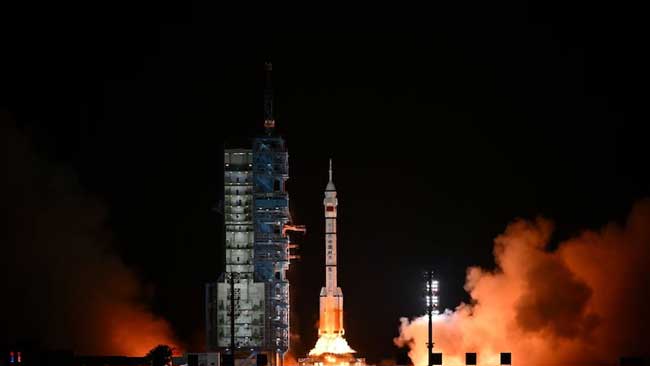
Desk : China successfully launched the Shenzhou-23 mission on Sunday, marking a significant step forward in its long-term human spaceflight and lunar exploration ambitions. The mission includes preparations for the country’s goal of sending astronauts to the Moon by 2030.
The Long March 2F rocket lifted off on schedule at 11:08 pm local time (1508 GMT) from the Jiuquan Satellite Launch Centre in northwest China’s Gobi Desert, according to footage broadcast by state media CCTV. The China Manned Space Agency (CMSA) confirmed that the spacecraft separated from the rocket roughly 10 minutes after launch and successfully entered orbit.
Officials said the launch was a complete success and confirmed that all three astronauts aboard were in good condition.

The crew includes 43-year-old Li Jiaying (Lai Ka-ying in Cantonese) from Hong Kong, marking the first time an astronaut from Hong Kong has gone into space. Li previously served in the Hong Kong police force. He is joined by 39-year-old space engineer Zhu Yangzhu and 39-year-old former air force pilot Zhang Zhiyuan, who is undertaking his first spaceflight.
Before the launch, a farewell ceremony was held where cheering crowds waved Chinese flags as the astronauts saluted on stage while a band performed.
The mission will involve a range of scientific experiments in life sciences, materials science, fluid physics, and medical research. A key objective is to study the effects of long-duration spaceflight, including a planned one-year stay in orbit by one crew member.
According to CMSA, the astronaut selected for the year-long mission will be announced later, depending on mission progress. Experts say the experiment will help researchers better understand the long-term effects of microgravity, including bone density loss, muscle atrophy, radiation exposure, sleep disruption, and psychological stress.
Space experts have noted that the mission is also crucial for testing life-support systems such as air and water recycling, as well as medical preparedness for emergencies far from Earth.
The Shenzhou-23 mission forms part of China’s broader plan to develop sustained human presence in space through its Tiangong space station and advance preparations for future lunar and Mars missions. Previously, Chinese astronauts aboard Tiangong have typically completed missions lasting around six months.
China is also developing its next-generation spacecraft, Mengzhou, with an orbital test flight planned for 2026. This new spacecraft is expected to eventually replace the Shenzhou series and support future crewed lunar missions.
Beijing aims to establish a preliminary crewed lunar research base, known as the International Lunar Research Station (ILRS), by 2035.
In addition, China has announced plans to send its first foreign astronaut, from Pakistan, to the Tiangong space station later this year.
Over the past three decades, China has significantly expanded its space programme with heavy investment, closing the gap with established space powers such as the United States, Russia, and Europe. Notable achievements include the 2019 landing of the Chang’e-4 probe on the far side of the Moon—the first such mission in history—and the 2021 landing of a rover on Mars.
China has been excluded from the International Space Station (ISS) since 2011, following US legislation restricting cooperation with NASA, leading Beijing to independently develop and operate its own space station.