
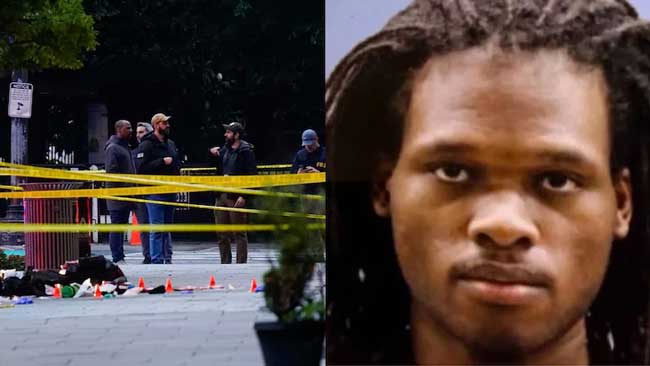
A man walked into the most heavily guarded address in the United States, allegedly pulled a weapon from his bag, and opened fire at a White House security checkpoint. Within moments, he was dead. But what remains far more disturbing than the exchange of bullets is the pattern that preceded it — a trail of warnings, delusions, mental health crises, and repeated proximity to the very heart of American power.
According to reports, the 21-year-old suspect had previously identified himself as the “real” Osama bin Laden, and at other times claimed to be a modern incarnation of Jesus Christ. He had allegedly posted threats online targeting President Donald Trump and expressed a desire to cause harm. This was not an unknown individual drifting silently through the margins of society; he had already been on the radar of federal authorities. He had previous encounters with the Secret Service. He had been detained, evaluated, and even committed for psychiatric assessment. He had allegedly violated court orders restricting his access to the White House perimeter.
And yet, on Sunday morning, he reportedly returned.


This raises uncomfortable questions that cannot be brushed aside with procedural explanations or retrospective investigations. How does an individual with repeated contact history near the White House, documented mental health concerns, and prior detentions still manage to reach a security checkpoint armed? At what point does a system designed to detect risk fail not once, but repeatedly?
It would be simplistic—and dangerous—to treat this merely as an isolated act of violence. It is equally reductive to reduce it only to mental illness. The truth lies in the collision of multiple failures: gaps in threat assessment, limitations in follow-through after psychiatric intervention, and the inherent unpredictability of individuals who oscillate between delusion and intent.
There is also a broader political backdrop that cannot be ignored. The report notes that Trump was inside the White House at the time of the incident, and that this event follows a series of recent security scares involving gunfire near high-profile locations in Washington. Whether connected or coincidental, the cumulative effect is the same: an atmosphere of heightened vulnerability around national leadership.
Security agencies will undoubtedly review protocols, timelines, and prior interactions. Reports will be written. Procedures will be revised. But those are post-facto reactions. The harder challenge is upstream: identifying when repeated behavioral red flags demand sustained intervention rather than temporary containment.
This incident is not just about a gunfire exchange at a checkpoint. It is about the fragile boundary between visible warning signs and irreversible action. When that boundary fails, the consequences are immediate, violent, and deeply revealing.
The question now is not only how this happened — but how many warnings a system can afford to miss before it stops calling them warnings at all.