

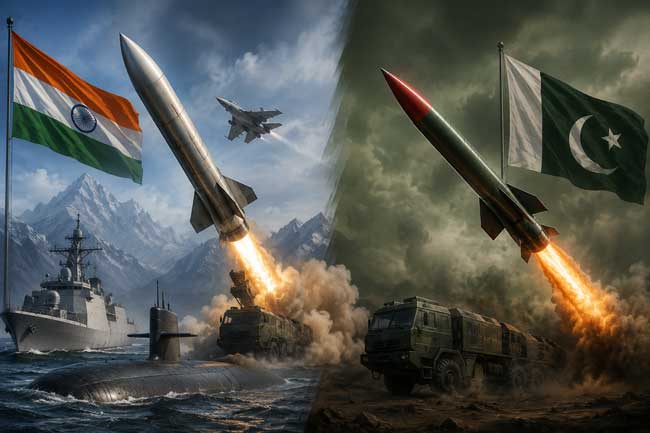
In South Asia’s strategic landscape, missiles are not merely weapons; they are symbols of a nation’s scientific capability, military preparedness, and strategic confidence. That is why the name of India’s BrahMos missile represents far more than a supersonic strike system. It reflects decades of technological advancement, disciplined military planning, and a determined push toward defence self-reliance. In contrast, Pakistan’s newly projected “Fatah-3” missile appears less like a genuine strategic equal and more like an attempt to create psychological parity with India.
The debate intensified after “Operation Sindoor,” which once again highlighted the widening gap between the military capabilities of the two nations. The difference does not lie only in speed or range, but in the entire defence ecosystem that India has steadily built over the past two decades. BrahMos today is not simply a missile in inventory; it has become an integrated pillar of India’s military doctrine. Its deployment across the Army, Navy, and Air Force gives India a multidimensional strike capability that significantly enhances deterrence.
Pakistan’s strategic challenge is deeper than the development of a single missile system. Modern warfare is no longer determined solely by possession of technology, but by the ability to integrate, sustain, and effectively deploy it under real combat conditions. Despite the claims surrounding Fatah-3, Pakistan still lacks the broader military infrastructure and operational depth needed to convert such systems into long-term strategic superiority. Defence analysts have repeatedly pointed out that Pakistan’s missile programme remains heavily dependent on Chinese and foreign technological support, limiting the scope of indigenous innovation and strategic autonomy.


India, on the other hand, has moved beyond rhetoric in its pursuit of defence self-reliance. The success of BrahMos is rooted in sustained coordination between scientific institutions, defence research agencies, and military leadership. Over the years, the missile has earned a reputation for precision, speed, survivability, and electronic warfare resistance. Its supersonic velocity dramatically reduces enemy reaction time, making it one of the most formidable tactical weapons in the region.
The reality of modern conflict has also evolved far beyond conventional battlefield engagements. Today’s wars are shaped by integrated air defence systems, cyber capabilities, intelligence networks, and real-time surveillance. India’s layered defence shield — including systems such as S-400 and Akash — has strengthened not only its defensive posture but also the effectiveness of its offensive capabilities. For Pakistan, the challenge is therefore not merely to build a missile comparable to BrahMos, but to create an entire defence architecture capable of supporting such power.
India’s growing confidence on the global stage reflects more than military expansion; it signals the emergence of a strategically assertive nation willing to invest in long-term security capabilities. Pakistan, meanwhile, still appears trapped in a reactive framework, responding to India’s advances rather than setting its own strategic direction. This is precisely why the promotion surrounding Fatah-3 generates more noise than confidence. It lacks the operational maturity and tested credibility that BrahMos has earned over years of deployment and refinement.
Peace in South Asia cannot ultimately be secured through an endless arms race. Yet history repeatedly demonstrates that peace is protected through strength. India’s defence modernisation reflects that understanding. BrahMos has now become more than a missile system — it is a symbol of technological confidence, strategic maturity, and a nation increasingly determined to shape its own security future.