

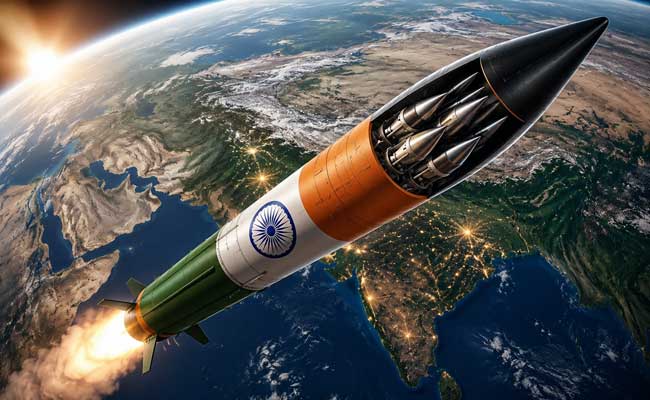
India’s reported progress toward the development and testing of the Agni-6 intercontinental ballistic missile marks a significant moment in the country’s long-term strategic defence evolution. If the ongoing developments by the Defence Research and Development Organisation (DRDO) move forward as anticipated, this system will represent a major leap in India’s indigenous missile technology and deterrence architecture.
The Agni-6 is expected to extend India’s strategic reach to over 10,000 kilometres, placing it among the most advanced systems of its kind globally. More importantly, its potential integration of Multiple Independently Targetable Re-entry Vehicle (MIRV) technology signals a qualitative transformation in capability. A single missile being able to deliver multiple warheads to separate targets not only increases operational efficiency but also significantly enhances strategic flexibility in a complex security environment.
What makes this development particularly noteworthy is not just the range or payload capability, but the underlying message of technological self-reliance. Over the years, India’s missile programme has steadily progressed from basic delivery systems to highly sophisticated platforms capable of countering evolving global missile defence shields. The Agni series has been central to this journey, and the Agni-6, as reported, appears to be the next logical and ambitious step forward.


From a strategic standpoint, such advancements strengthen India’s deterrence posture without altering its stated doctrine of credible minimum deterrence. Instead, they reinforce it. In an era marked by rapid technological militarisation and shifting global power equations, the ability to maintain a secure and credible second-strike capability is considered essential for national security stability.
Equally important is the role of the DRDO in this trajectory. The organisation’s continued focus on indigenous design, development, and testing reflects a broader national commitment to reducing external dependency in critical defence technologies. Each milestone achieved in this direction not only strengthens military preparedness but also boosts confidence in India’s scientific and engineering ecosystem.
While formal approvals and testing timelines are awaited, the reported readiness of the system underscores the momentum India has built in strategic defence research. If successfully developed and inducted, the Agni-6 will not merely be another addition to the arsenal; it will stand as a symbol of technological maturity, strategic confidence, and India’s evolving role in global security architecture.
In essence, the development reflects a clear message: India is steadily advancing toward a future where its defence capabilities are defined not by dependency, but by indigenous strength, precision engineering, and strategic foresight.