
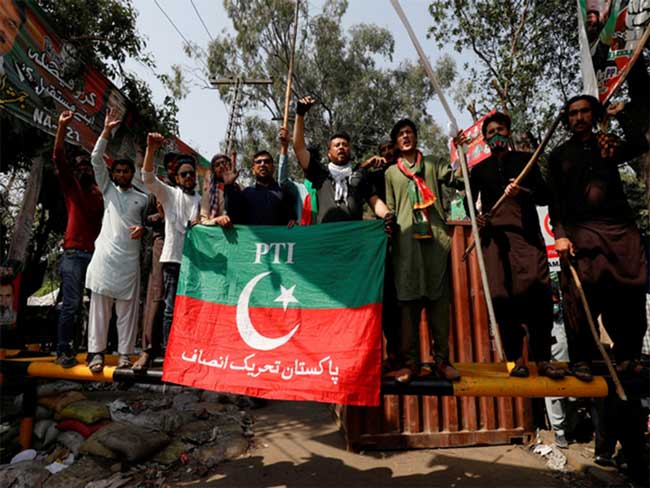
Desk : Pakistan’s opposition parties have launched a sharp and coordinated attack on the federal government, accusing it of economic mismanagement, rising authoritarianism, and a sustained crackdown on media freedoms, according to a report by Dawn.
In a series of strong statements issued on Saturday, senior leaders of the Pakistan Tehreek-e-Insaf (PTI) and its allied political groups criticised the ruling administration for what they described as “incompetence” and the increasing use of coercive measures to maintain political control.
During a press briefing, National Assembly Opposition Leader Mahmood Khan Achakzai issued a stern warning to the country’s security establishment, urging it to refrain from political interference. “Politics is not their domain and they must stay within their constitutional role,” he said, cautioning that Pakistan was sliding towards internal instability.


Separately, PTI Central Information Secretary Sheikh Waqas Akram launched a detailed critique of the government’s economic performance, highlighting what he termed as uncontrolled inflation and policy failure across key sectors. He stated that double-digit inflation had surpassed official estimates, sharply increasing the cost of essential goods, including food, electricity, fuel, and transport.
Akram accused the government of attempting to deflect responsibility by blaming global economic conditions, a justification the PTI firmly rejected. He argued that several neighbouring countries had managed the global economic downturn more effectively.
According to him, continuous increases in petroleum prices have further intensified financial pressure on citizens, making basic commodities increasingly unaffordable. The PTI demanded an immediate reduction in petroleum levies and urgent policy measures to provide relief to the public.
Raising concerns over press freedom, Akram cited findings from Reporters Without Borders (RSF), claiming that media independence has reached a “critical low point.” He alleged that Pakistan is witnessing rising censorship, pressure on journalists, and misuse of legal frameworks to suppress dissent, calling such practices “deeply damaging to democracy.”
The PTI also criticised what it called a “selective” anti-encroachment drive in Islamabad, alleging that while action against affluent housing complexes was halted, demolitions in low-income areas continued, leaving vulnerable communities homeless.
In addition, the party pointed to governance failures in Sindh under the Pakistan Peoples Party (PPP), particularly in the health sector. Akram claimed that over 75 percent of senior health management positions remain vacant, which he said has weakened the province’s ability to respond to outbreaks such as dengue, malaria, and HIV.
“This is not a minor administrative gap but a serious collapse of leadership and oversight,” he said.
In a parallel statement, Mahmood Khan Achakzai also alleged that efforts were underway to engineer a “minus-Imran Khan” political environment. He claimed that “real leadership is in jail while individuals of questionable credibility occupy legislative seats,” and criticised what he described as the weakening of democratic institutions, including the judiciary.
Echoing similar sentiments, PTI Secretary General Salman Akram Raja stressed that political repression would not suppress public sentiment. He said the release of PTI founder Imran Khan was central to both political stability and economic recovery, and reiterated the party’s commitment to continue its campaign for the release of Khan and other detained leaders.
The opposition’s coordinated statements highlight deepening political tensions in Pakistan, as criticism of governance, economic conditions, and institutional roles intensifies across the political spectrum, Dawn reported.