

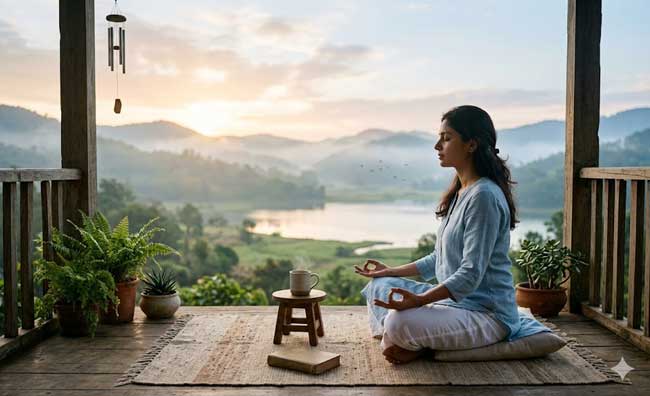
 In the rush of modern life, one of the greatest paradoxes is that while humans have more words than ever to speak, they have less inner space to truly listen. The constant movement of work, conversations, digital noise, and emotional obligations gradually exhausts the mind—often without us even realizing what exactly is draining us.
In such a life, Sunday is not just a day of rest. It can become an opportunity—a gentle pause to return to oneself, to observe what lies beneath the surface of constant activity. Within this context, silence becomes not an absence of speech, but a conscious spiritual practice.
Silence is often misunderstood as simply not speaking. In its deeper sense, silence is the stillness of the mind—the gradual withdrawal from the endless stream of thoughts, reactions, and internal commentary. When outer speech stops, inner awareness begins to emerge.


Sunday mornings are particularly suited for this practice. After a long week of continuous engagement, both body and mind naturally seek rest. If even a few hours are spent in intentional silence—away from unnecessary conversations, digital interruptions, and constant stimulation—the experience can be profoundly transformative.
At first, silence may feel uncomfortable. The mind resists. Thoughts become louder, memories surface more intensely, and there is an initial sense of restlessness. But this is not failure; it is the beginning of awareness. As one continues, the mind slowly begins to settle, like dust particles in still water.
With time, silence reveals something deeper: that not every question requires external answers. Many of the conflicts we carry are not solved through discussion, but through observation. In silence, we begin to hear ourselves more clearly than we ever do in speech.
From a spiritual perspective, silence is not withdrawal from life—it is deeper engagement with it. It is a state where awareness replaces reaction, and presence replaces distraction. In this space, meditation arises naturally, without force or effort.
Practicing silence on Sundays can gradually reshape the entire week. It builds emotional clarity, patience, and a subtle strength that is not dependent on external validation. It becomes a foundation for inner balance rather than an isolated activity.
Ultimately, silence is not distance from the world, but closeness to oneself. And perhaps Sunday arrives each week to remind us of a simple truth: that sometimes, understanding life does not require more words—it requires silence.