

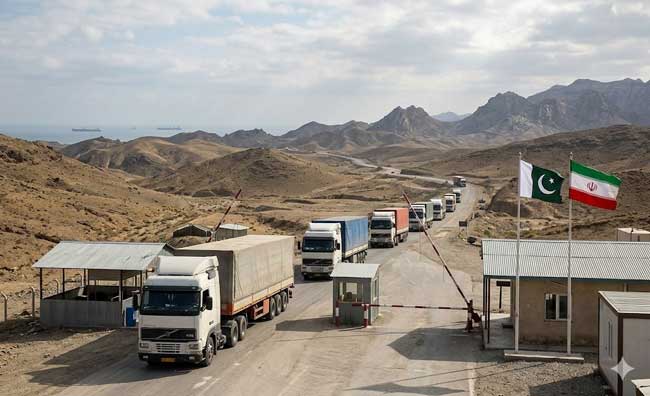
In a move that has drawn international attention, Pakistan has opened six land trade routes with Iran even as the United States, under former President Donald Trump, continues to enforce strict economic pressure on Tehran. The decision, reportedly taken by the government of Shehbaz Sharif, highlights Islamabad’s attempt to navigate a complex geopolitical landscape shaped by competing global interests.
A Move Amid Rising Tensions
The development comes at a time of heightened tensions between the United States and Iran. Washington’s efforts to isolate Tehran—through sanctions and restrictions on trade routes—have significantly disrupted regional commerce, particularly maritime trade passing through critical chokepoints.
With sea routes facing uncertainty, Pakistan’s decision to activate multiple overland corridors into Iran is being viewed as both a practical and strategic response. These routes are expected to facilitate the movement of essential goods, reduce logistical bottlenecks, and provide an alternative channel for trade that bypasses affected maritime pathways.


Economic Compulsions at Play
Pakistan’s economy, already under strain, has been impacted by rising fuel prices and supply disruptions linked to the broader US-Iran standoff. Opening land routes offers Islamabad a way to cushion these economic shocks by ensuring continuity in cross-border trade.
Officials believe that maintaining trade flows with Iran is crucial, especially for border regions where local economies depend heavily on bilateral commerce. The step is also seen as a measure to stabilize domestic markets facing inflationary pressure due to global uncertainties.
Diplomatic Tightrope
However, the move places Pakistan in a delicate diplomatic position. On one side, it maintains longstanding ties with the United States, which remains an important economic and strategic partner. On the other, Iran is a neighboring country with which Pakistan shares deep cultural, economic, and geographic links.
By opening trade routes at a time when Washington is attempting to tighten restrictions on Tehran, Islamabad risks being perceived as undermining American efforts. At the same time, Pakistan has consistently advocated for dialogue and de-escalation, positioning itself as a potential mediator in the crisis.
Strategic Significance
Analysts suggest that Pakistan’s decision reflects a broader strategy of “balanced diplomacy”—a careful effort to maintain working relationships with multiple global powers without becoming directly entangled in their conflicts.
The opening of these routes may also strengthen Pakistan-Iran ties, potentially leading to deeper economic cooperation in the future. For Iran, access to land-based trade channels offers partial relief from external pressures, while for Pakistan, it reinforces regional connectivity.
Global Implications
The development carries wider implications for regional and global dynamics:
- It could complicate US efforts to isolate Iran economically.
- It highlights the limitations of unilateral sanctions in a multipolar world.
- It underscores the growing importance of alternative trade corridors in times of geopolitical crisis.
Conclusion
Pakistan’s decision to open trade routes to Iran is rooted in economic necessity but carries significant geopolitical weight. As tensions between major powers continue to shape global trade and diplomacy, Islamabad’s balancing act will be closely watched.
Whether this move leads to friction with Washington or strengthens Pakistan’s regional standing remains to be seen. What is clear, however, is that in an increasingly complex world order, middle powers like Pakistan are carving out their own space—guided as much by necessity as by strategy.