
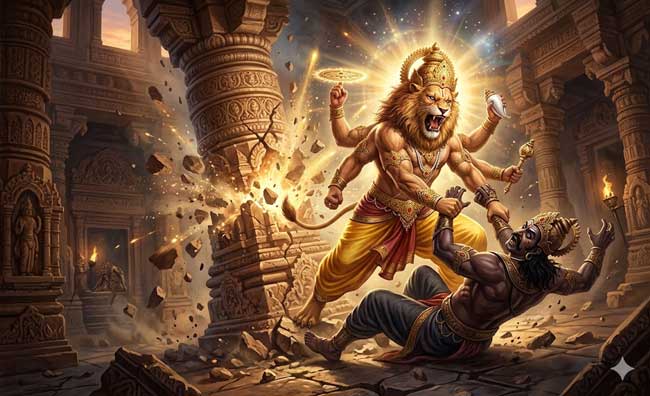
 When creation itself becomes trapped in its own rules, when righteousness begins to fear and unrighteousness grows blind with ego, the Divine does not appear in a conventional form. Instead, it manifests in a way that shatters every limitation. The Narasimha avatar is a powerful expression of this eternal truth.
This is not merely a mythological story; it is a declaration of a universal principle—that the Divine is never bound by form, time, or logic. When cosmic balance is disturbed, divinity reveals itself in ways that transcend human understanding.
The ego of Hiranyakashipu was not just the arrogance of a king. It represents every mindset that believes itself to be absolute and invincible. He convinced himself that death could not come in the day or night, inside or outside, by man or beast. In his illusion of control, he forgot a simple truth: the creator of rules is never bound by them.


And it was the unwavering devotion of Prahlad that opened the doorway where logic ends and divinity begins.
The Narasimha form—half man, half lion—symbolizes that God cannot be confined to a single definition. He is neither fully human nor fully animal; He is the consciousness that permeates all forms yet is limited by none.
When the pillar split open, it was not just the end of a tyrant. It was the revelation that truth cannot be suppressed and devotion cannot be destroyed.
Narasimha is not merely a symbol of anger. He represents the moment of divine justice where time itself pauses and truth manifests in its absolute form. His appearance teaches that when systems remain silent and injustice becomes loud, the Divine intervenes—at any time, in any form.
Even today, this story remains deeply relevant. In modern life too, ego, power, and falsehood often appear unstoppable. Yet the Narasimha avatar reminds us that no authority, no power, and no system stands above truth.
Narasimha Jayanti is not just a day of worship; it is a moment of introspection—to recognize the ego within and to preserve the kind of devotion that remains unshaken like Prahlad’s.
Because when devotion is absolute, the Divine does manifest—sometimes in forms beyond all boundaries.