

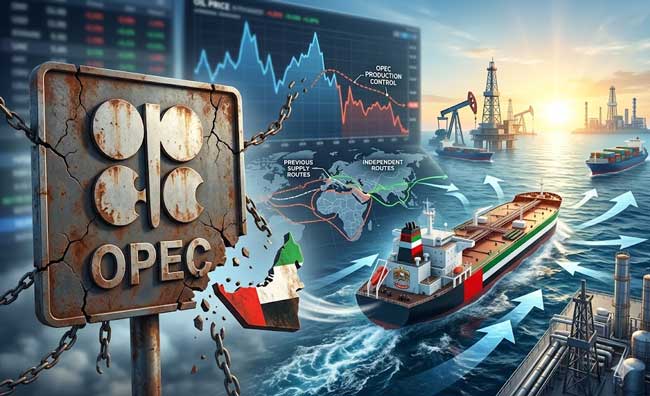
Desk : In a major development that could reshape global energy politics, the United Arab Emirates (UAE) has announced its decision to withdraw from the Organization of the Petroleum Exporting Countries (OPEC) and the OPEC+ alliance. The decision will come into effect from May 1, 2026.
The move is being seen as one of the most significant shifts in global oil governance in recent years, especially at a time when the world is already grappling with an ongoing energy crisis and geopolitical tensions.
Decision Driven by National Strategy
According to an official statement from the UAE government, the decision has been taken in line with the country’s “national interests, economic priorities, and investment strategy.” The UAE stated that it now seeks greater autonomy in shaping its oil production policies to respond more flexibly to global market conditions.

Global Energy Crisis Context
The announcement comes amid heightened instability in global energy markets. Ongoing tensions in the Middle East, including disruptions linked to Iran and risks around the Strait of Hormuz—a critical oil transit route—have already raised concerns over supply security.
Experts believe the UAE’s exit could weaken OPEC’s coordinated production control system, which has historically played a key role in stabilizing global oil prices.
Major Blow to OPEC Unity
The UAE has long been considered one of the key members of OPEC. Its departure is being viewed as a strategic and political setback for the organization. Analysts suggest it could reduce the influence of Saudi Arabia-led OPEC decisions and increase volatility in global crude oil pricing.
Impact on Global Oil Markets
Following the announcement, early reactions in energy markets showed volatility. Traders and investors are concerned that reduced coordination among oil-producing nations may lead to unpredictable supply adjustments and price fluctuations.
Some analysts also expect that the UAE may pursue an independent production strategy, potentially increasing output to maximize economic gains.
Geopolitical Implications
Beyond economics, the decision carries strong geopolitical significance. It signals a possible realignment in Middle Eastern energy politics and could mark a shift toward more fragmented global oil governance.