
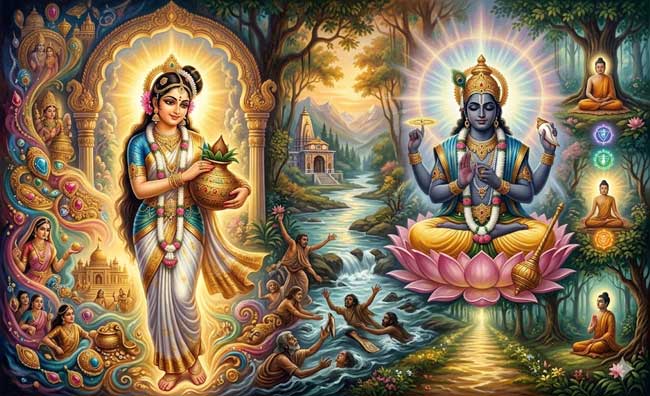
In this world, not everything that appears before the eyes is true, and not every truth is visible to the eyes. This is  one of life’s deepest mysteries. The world is filled with attractions—beauty, wealth, status, relationships, power, and endless desires. Human beings often mistake these shining appearances for reality, while the soul silently calls them toward something far deeper. This is the eternal conflict between illusion and truth.
In the Sanatan tradition, the Mohini form of Lord Vishnu is not merely a mythological episode, but a profound spiritual message. During the great Samudra Manthan, when the nectar of immortality emerged, both the Devas and Asuras desired it. At that moment, Lord Vishnu assumed the enchanting form of Mohini—so captivating that the Asuras lost their wisdom and judgment. Entranced by outer beauty, they were distracted, and the nectar slipped from their hands.
This story is not only about the Asuras. It is the story of every human being.


Even today, the world stands before us in many forms of Mohini. Sometimes as wealth, sometimes as fame, sometimes as false relationships, sometimes as ego, and sometimes as the endless hunger for recognition. People become entangled in these attractions and lose the true nectar within themselves—peace, contentment, love, and self-realization. They run outward, yet remain empty within.
The Mohini form does not teach that beauty or the world is evil. Rather, it teaches that anything which destroys wisdom and inner balance becomes illusion. Living in the world is not the problem; becoming drowned in it is.
The truth of the soul is entirely different. The soul is not bound by appearance, possessions, praise, or insult. It is calm, luminous, eternal, and steady. When a person turns inward through meditation, devotion, noble actions, and spiritual discipline, they discover that the happiness they were chasing outside had always existed within.
The Mohini form of Lord Vishnu is both a warning and a blessing. It warns us to be cautious of glittering distractions. It blesses us with the understanding that once illusion is recognized, it can become a teacher. The one who understands deception moves closer to truth.
Modern humanity lives in an age of technology, consumption, and comparison. Every day new Mohinis appear—luxurious lifestyles, superficial success, social validation, and endless desires. In such a time, the message of Mohini Ekadashi becomes even more relevant: let fasting not be only from food, but also from greed, anger, pride, and restless cravings.
When the mind becomes free from attachment, the truth of the soul reveals itself.
Ultimately, the divine play of Mohini teaches us that we do not need to run away from the world—we need to understand it. The one who understands illusion becomes free. The one who remains trapped in it continues to wander. Therefore, before gazing at the outer Mohini, awaken the Vishnu within. There lies truth. There lies nectar. There lies eternal peace.