
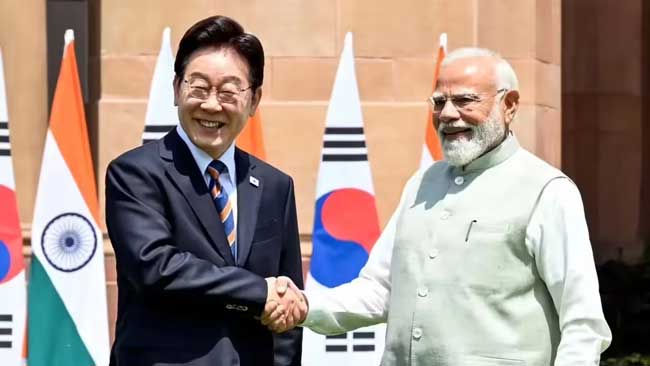
New Delhi: Prime Minister Narendra Modi on Monday warmly welcomed South Korean President Lee Jae-myung on his first state visit to India, describing his life as a powerful example of struggle, service, and dedication.
Following delegation-level talks at Hyderabad House in New Delhi, the two sides exchanged several Memorandums of Understanding (MoUs) aimed at strengthening bilateral cooperation. A joint press statement marked the occasion, highlighting a new phase in India–South Korea relations.
Addressing the media, Prime Minister Modi said President Lee’s visit was highly significant and would further strengthen the strategic partnership between the two countries. He noted that democratic values, market economy principles, and respect for the rule of law form the shared foundation of both nations, along with a common outlook in the Indo-Pacific region.

The Prime Minister said that India–South Korea relations have become more dynamic and comprehensive over the past decade and are now moving toward a “future-oriented partnership.” He emphasized expanding cooperation across key sectors including chips and ships, technology, talent, energy, and environment to ensure mutual growth and prosperity.
On the economic front, PM Modi highlighted that bilateral trade currently stands at around $27 billion, with a shared goal of increasing it to $50 billion by 2030.
To support this ambition, several new initiatives were launched, including the India–Korea Financial Forum, an Industrial Cooperation Committee, and an Economic Security Dialogue to enhance financial flows, industrial collaboration, and supply chain resilience.
The Prime Minister also announced steps to support Korean companies, particularly small and medium enterprises, by developing Korean industrial townships in India. He added that the India–Korea Trade Agreement will also be upgraded within the next year to further ease business engagement.
The visit marks a significant milestone in bilateral relations, with both countries reaffirming their commitment to deepening strategic, economic, and technological cooperation for the future.