

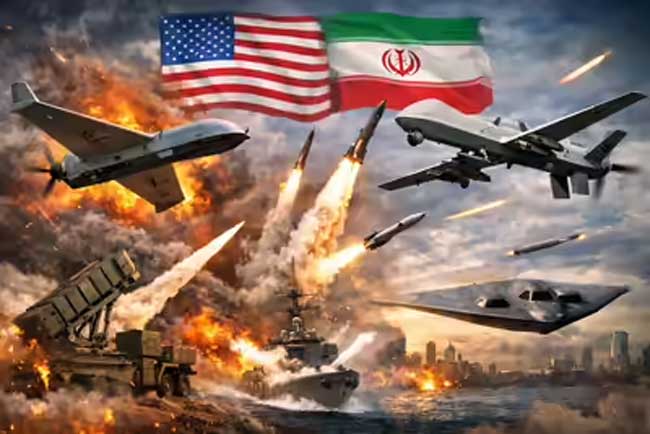
Whenever a major geopolitical conflict emerges, its impact is not limited to borders, armies, or diplomacy alone. It also reshapes public discourse and introduces new strategic vocabulary. The growing tensions involving the United States, Israel, and Iran have brought several such terms into global discussion, many of which are now frequently used in international media and policy debates.
This is not merely a military confrontation. It is also a conflict of narratives, technology, intelligence, and psychological strategy. In this context, understanding these widely used terms has become essential to understanding the modern global order.
1. Strait of Hormuz
One of the world’s most critical maritime chokepoints, the Strait of Hormuz carries a significant share of global oil exports. Any disruption or military tension in this region can directly affect international energy prices and the world economy.

2. Shahed Drone
Developed by Iran, Shahed drones are low-cost loitering or suicide drones designed to strike targets by crashing into them. They have become an increasingly visible tool in modern asymmetric warfare.
3. Proxy War
A proxy war occurs when major powers avoid direct confrontation and instead support allied states, militias, or groups to fight on their behalf. It has become a defining feature of contemporary geopolitics.
4. Precision Strike
These are technologically advanced attacks aimed at specific military targets with minimal collateral damage. Precision strikes are often used to achieve maximum strategic impact with controlled escalation.
5. Weaponization of Energy
This term refers to the use of oil, gas, or other energy supplies as tools of political pressure or strategic leverage against rivals.
6. War Fatigue
War fatigue describes the physical, emotional, and political exhaustion that develops among soldiers and civilians during prolonged conflicts. It can significantly influence public opinion and policy decisions.
7. Back-Channel Talks
These are secret or informal negotiations conducted away from public scrutiny, often used to reduce tensions or explore diplomatic settlements.
8. Deterrence
Deterrence is a strategy in which a nation seeks to prevent aggression by convincing adversaries that any attack will invite severe retaliation.
9. Red Line
A red line is a clearly stated limit or condition, crossing which may trigger strong military or political action.
10. Information Warfare
Though often less visible than missiles or troops, information warfare includes propaganda, cyber influence, disinformation, and narrative control designed to shape perceptions during conflict.
Conclusion
Today’s conflicts are no longer fought only with tanks, missiles, and soldiers. They are also fought through technology, strategy, economics, and language itself. These trending terms reveal how modern warfare has evolved into a multidimensional contest that extends far beyond the battlefield.