

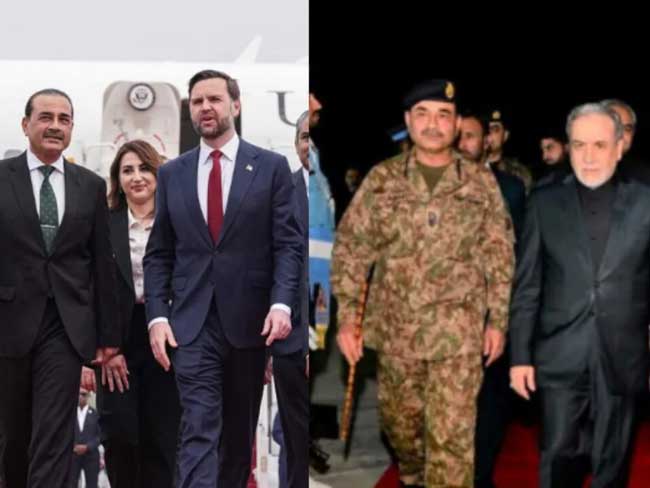
In the middle of high-stakes diplomatic activity in Islamabad, one visual quietly stole global attention—Asim Munir switching between a military uniform and a formal suit. This wasn’t a matter of wardrobe—it was a calculated display of Pakistan’s dual-track strategy.
When the Iranian delegation arrived, Munir appeared in full military uniform—projecting strength, command, and a readiness for confrontation. But when U.S. Vice President JD Vance landed in Islamabad, the same man greeted him in a tailored suit—measured, diplomatic, and open to engagement.
Not Optics, But Strategy
In global politics, symbolism is never accidental. Clothing, posture, and presentation often communicate what words carefully avoid.


- The uniform said: “We are power. We are prepared.”
- The suit signaled: “We are partners. We are open to dialogue.”
Within hours, Munir embodied both messages. This reflects a long-standing pattern in Pakistan’s foreign policy—projecting toughness to regional players while presenting flexibility to Western powers.
The Deeper Question: Who Really Holds Power in Pakistan?
Perhaps the most telling detail was not what Munir wore—but who received the delegations.
Not the elected Prime Minister, but the Army Chief.
This raises an uncomfortable but familiar question:
Is Pakistan’s power structure truly democratic, or does real authority still rest with the military establishment?
“Dress Diplomacy” or Strategic Double Game?
Analysts have termed this episode as “dress diplomacy,” but that may be too mild a phrase.
Displaying rigidity to Iran while signaling accommodation to the United States could also be interpreted as a calibrated double game—one that Pakistan has historically been accused of playing.
Balancing global powers is one thing. Sending contradictory signals is another.
Why This Moment Matters
The timing makes it even more significant. With U.S.-Iran tensions at a sensitive peak, Pakistan is positioning itself as a potential intermediary.
But can a state that sends mixed signals through even its symbolic gestures be trusted as a neutral mediator?
Conclusion: Optics Reveal Intent
Asim Munir’s uniform and suit were not just clothing—they were statements.
One projected force. The other suggested diplomacy.
Together, they revealed a deeper truth:
Pakistan’s foreign policy continues to operate on shifting signals rather than clear positions.
Power in uniform, persuasion in a suit—
this is not just style, it is strategy.