

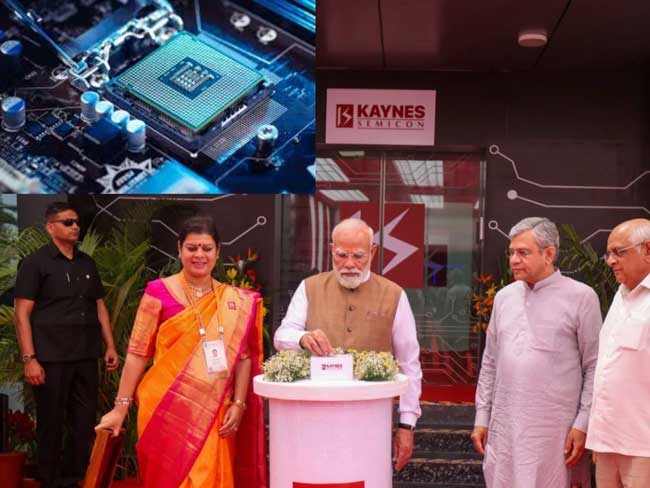
Signalling a decisive shift from being a technology consumer to a global manufacturing hub, Prime Minister Narendra Modi on Tuesday inaugurated a ₹3,300-crore semiconductor facility at Sanand GIDC in Gujarat. Developed by Kaynes Semicon, the plant marks a significant milestone in India’s push to build a robust domestic semiconductor ecosystem.
Commercial production begins
The newly inaugurated unit is an OSAT (Outsourced Semiconductor Assembly and Test) facility, which focuses not on chip fabrication but on assembly, packaging, and testing—critical stages in the semiconductor value chain. In simple terms, the plant integrates smaller chip components into usable, market-ready products.
Notably, commercial production has already commenced, underlining the project’s readiness and operational scale.
Focus on next-generation applications
The facility has begun manufacturing Intelligent Power Modules (IPMs), components that are increasingly essential in sectors such as electric vehicles (EVs), industrial automation, and energy-efficient systems.
With EV adoption accelerating globally, the production of IPMs is expected to give a strong boost to India’s emerging clean mobility and smart electronics ecosystem.


Boost to global supply chain integration
Speaking at the inauguration, Prime Minister Modi emphasised that the facility would strengthen India’s position in the global semiconductor supply chain. Referring to the government’s twin focus on “Make in India” and “Make for the World,” he highlighted that a significant portion of the plant’s output is expected to be export-oriented.
This move aligns with India’s broader ambition to become a reliable alternative in global chip manufacturing, at a time when supply chains are being diversified worldwide.
Part of India Semiconductor Mission
The plant has been set up under the India Semiconductor Mission, a flagship initiative aimed at building a comprehensive semiconductor and display manufacturing ecosystem in the country.
It is the second operational semiconductor unit in India, following the earlier facility established by Micron Technology.
Capacity and economic impact
Once fully operational, the Sanand facility is expected to produce around 6.3 million units per day. This scale of output is likely to significantly reduce India’s dependence on semiconductor imports, while simultaneously boosting employment generation and industrial growth.
Industry experts believe that such investments will not only strengthen domestic manufacturing capabilities but also attract further global players to India’s semiconductor sector.
A step towards technological self-reliance
Beyond its immediate industrial impact, the project represents a broader strategic shift. As nations increasingly view semiconductors as critical infrastructure, India’s growing footprint in this sector underscores its ambition to emerge as a technology powerhouse.
With more such projects in the pipeline, the Sanand plant is being seen as a stepping stone towards positioning India as a global semiconductor hub in the years ahead.