

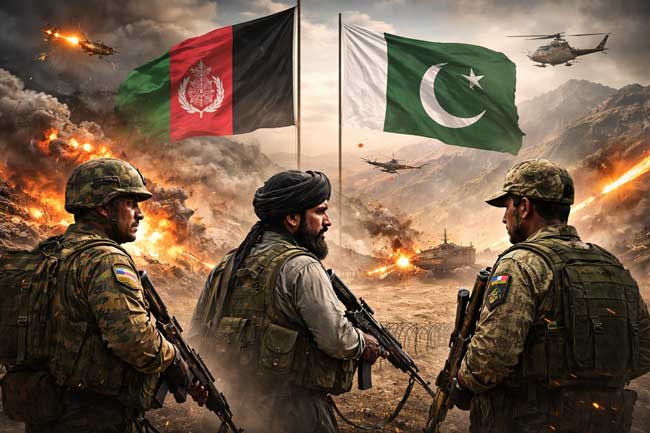
South Asia is currently engulfed in violence and conflict. On one front, the United States and Israel have intensified attacks on Iran, while Afghanistan and Pakistan are engaged in severe military clashes. Tensions between the two neighbors have escalated since the end of February 2026, with Pakistan repeatedly carrying out airstrikes across Afghanistan.
For India, this is not just a skirmish between two countries. It is a significant development that directly impacts its western borders, energy security, and the long-standing fight against cross-border terrorism.
Strategic Opportunity for India
Pakistan and Afghanistan have shared a long-standing history of close ties. Islamabad has historically sought to strengthen its strategic influence in Afghanistan. However, the situation is now beyond its control. Pakistan has suffered a major setback from the Taliban. Once considered Pakistan’s proxy, the Taliban now refuses to recognize the Durand Line after taking power in Afghanistan.


The ongoing conflict between Pakistan and the Taliban has created an important strategic opportunity for India. India has strongly condemned Pakistan’s airstrikes in Afghanistan and is positioning itself as a defender of Afghan sovereignty.
Significance for India’s Security and Diplomacy
At the center of the current conflict is Tehrik-e-Taliban Pakistan (TTP), a radical militant group. Pakistan accuses Afghanistan of providing safe haven to TTP. For India, this poses a double-edged challenge.
India’s foremost concern is preventing groups like ISIS-K or Al-Qaeda from re-emerging along its borders. At the same time, India seeks to strengthen its ties with Afghanistan. In line with this, New Delhi has increased humanitarian assistance to Afghanistan to ₹150 crore in the 2026-27 budget. The aim is to ensure that Afghanistan remains stable and no terrorist group uses its soil to target India.
Pakistan’s Strikes and Afghanistan’s Response
Pakistan claims that it has carried out airstrikes across Afghanistan targeting terrorist hideouts and networks. According to Islamabad, these strikes are part of “Operation Gajab‑lil‑Haq,” which began on February 26 and is ongoing. Pakistan says the operation responds to alleged attacks by Afghan Taliban forces along the 2,600-kilometer Pakistan-Afghanistan border.
However, the Afghan government has leveled serious allegations against Pakistan. An airstrike on a rehabilitation hospital in Kabul reportedly killed at least 400 people. Afghan officials say more than 50 bodies may still be trapped under the rubble.
According to “Tolo News,” rescue operations are ongoing. Pakistan, meanwhile, claims it has precisely targeted Taliban and Fitna al-Khwariz bases in Kabul and Nangarhar. These sites allegedly stored technical equipment and ammunition, which Pakistan claims were being used by militants against innocent civilians.
Implications and Future Outlook
The ongoing conflict between Afghanistan and Pakistan poses a threat not only to regional stability but also to India’s security and diplomatic objectives. India is actively working to use this situation to strengthen its relations with Afghanistan and prevent the spread of cross-border terrorism.
At the same time, the conflict weakens Pakistan’s strategic position and provides India an opportunity to enhance its presence and influence in the region.