
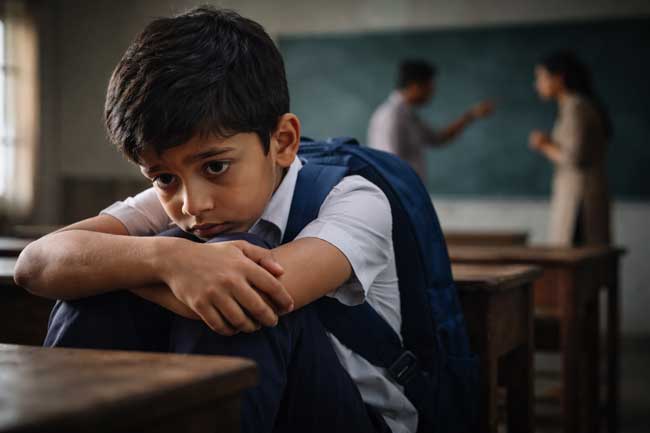
A child’s world is shaped by three spaces—home, school, and society. These are the places where confidence should be nurtured, where curiosity should be encouraged, and where failure should be treated as a part of learning. But are we truly playing that role?
Or are we, without realizing it, pushing children into an environment where scolding replaces conversation, fear is mistaken for discipline, and silence is confused with obedience?
Scolding: When Communication Turns into Humiliation
We often say, “We learned only because we were scolded.”
But we rarely ask—what did we lose in the process?
Constant scolding plants a quiet belief in a child’s mind that they are never good enough. Raised voices over small mistakes and harsh words after failure slowly erode self-confidence. The child stops asking questions, stops expressing emotions, and begins to withdraw. On the surface, they may appear well-behaved, but internally, they are breaking.


Scolding meant to correct can still harm if its language wounds. When words become weapons, learning gives way to fear.
Fear: Discipline or Mental Confinement?
In many homes and classrooms, fear is treated as a tool of discipline.
“They’ll study only if they’re scared.”
“If we aren’t strict, they’ll lose control.”
But discipline born out of fear is fragile and temporary. Fear may produce obedience, but it cannot build independence. A child raised in fear hesitates to make decisions, avoids taking risks, and constantly worries about being wrong.
Over time, this fear consumes their thinking, suppresses creativity, and damages self-worth.
Depression: The Invisible Struggle
The most alarming truth is that childhood depression often goes unnoticed.
Children continue going to school, smiling in public, appearing “normal”—while carrying a deep emptiness inside.
Their silence is mistaken for maturity.
Their isolation is dismissed as a phase.
Their exhaustion is labeled laziness.
By the time the signs are recognized, it is often too late.
This Is Not a Question About Children—It Is About Us
This is not an accusation against children.
It is a question for adults—parents, teachers, and society.
Do we listen to children, or do we only correct them?
Do we compare them, or do we understand their individuality?
Do we value results alone, or do we respect the process?
A child is not a report card, a rank, or a statistic. A child is a sensitive mind seeking trust, safety, and understanding.
The Way Forward: Sensitivity, Not Severity
Children need discipline—but not through fear.
They need guidance—but without humiliation.
They need boundaries—but built on conversation.
Before scolding a mistake, try to understand it.
Before shaming failure, stand beside the child.
Most importantly, never dismiss emotions as drama or exaggeration.
In Conclusion
Perhaps we are not deliberately breaking our children.
But if we do not pause, reflect, and change, the damage done unintentionally can be just as deep.
To raise strong children, we must replace fear with understanding.
Because a broken childhood often leaves wounds that last a lifetime.