

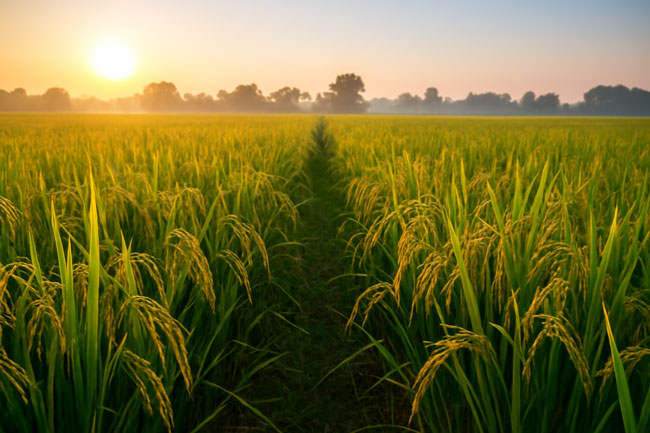
When the morning sun spreads across the lush green fields of Punjab, a familiar fragrance rises with the breeze—the aroma of Indian basmati. Long grains, delicate scent, and a taste perfected over centuries… a gift from Indian soil that now graces plates across continents. Whether it is biryani in an American restaurant or a steaming plate of rice in a Saudi Arabian home, the flavor carries the imprint of India.
According to the Indian Rice Exports Federation, India is the world’s largest rice producer, commanding 28% of global output and 30.3% of global exports in 2024–25. Varieties like Sona Masuri are especially popular in markets such as the US and Australia.
But India’s dominance wasn’t built overnight—it is the result of a long civilizational journey, from the fields of the Indus Valley to today’s gene-edited seeds.
Why the Sudden Debate?
Trump’s Remarks Ignite the Conversation**


A recent statement by US President Donald Trump sparked a renewed global discussion on Indian rice. During a White House roundtable with agricultural representatives, Louisiana rice miller Merrill Kennedy claimed that American farmers were struggling because countries like India and Thailand were “dumping” cheap rice into the US market.
Trump immediately questioned his cabinet:
“Why is India allowed to do this? Shouldn’t they be paying tariffs?”
Treasury Secretary Scott Besant replied that trade negotiations with India were underway, while Kennedy noted that a WTO case was also pending. Trump’s response was characteristically blunt—tariffs could “solve the problem very quickly.”
Yet behind the political theatrics lies a far more complex economic reality.
Ancient Roots: India and Rice Through the Ages
India’s relationship with rice is at least 5,000 years old. Excavations at Lothal and Rakhigarhi show that the Indus Valley people cultivated rice along riverbanks. Vedic texts describe rice as akshata, symbolizing prosperity and immortality, and it held ritual significance.
Through ancient maritime routes, Indian rice traveled to the Roman Empire and the Arab world.
The Mughal era marked a turning point—historians believe the term basmati (from bas – fragrance, and mati – goodness) became common in the 17th century. Grown in the Himalayan foothills—Punjab, Haryana, and Uttar Pradesh—it became a royal delicacy and soon found its way to Europe.
Under the British Raj, rice exports were formalized. By the late 19th century, India was feeding industrial-era Britain with its grain.
After Independence, the Green Revolution transformed Indian agriculture. Visionaries like M.S. Swaminathan developed hybrid seeds, fertilizers, and large-scale canal irrigation. India’s rice production soared—from 50 million tonnes in 1960 to over 150 million tonnes today—laying the foundation for massive exports.
Global Rise: India Becomes the Rice Powerhouse
By the 1990s, India began overtaking Thailand and Vietnam. The reason was simple—diversity. Premium basmati for rich markets, affordable non-basmati for developing nations.
By 2000, India captured 20% of global rice exports.
There were challenges. El Niño-induced droughts in 2007–11 and again in 2023 forced India to impose export bans, sending global prices to 15-year highs. This reminded the world that food security without India is incomplete.
Despite interruptions, India retained its crown—
the world’s largest rice exporter since 2011.
In 2023, India exported $11 billion worth of rice, with Saudi Arabia, Iran, Iraq, and several African nations as major buyers.
2025: A Historic Production High and Scientific Breakthroughs
The Kharif season of 2025–26 set a new national record—124.50 million tonnes of paddy.
IRRI and ICAR introduced 31 new climate-resilient varieties.
In May 2025, India unveiled the world’s first gene-edited rice varieties:
- DRR Dhan 100 (Kamala)
- Pusa DST-1
These cutting-edge seeds offer:
- 19% higher yield
- Improved drought tolerance
- 20% lower greenhouse gas emissions
A revolutionary milestone in global rice science.
The World’s Dependence on Indian Rice
Indian rice reaches 179 countries, including:
- Saudi Arabia
- Iran
- Iraq
- UAE
- USA
- Bangladesh
- Malaysia
- Nigeria
- Yemen
- Singapore
From the Middle East to Africa to Southeast Asia, India remains indispensable.
Between April 2024 and March 2025, India exported 19.865 million tonnes of rice.
The Indian Rice Exporters Federation is now targeting 26 new markets, including Japan, Indonesia, and Mexico.
Trump’s Tariff Threat: Loud in Words, Weak in Impact
Trump’s comments in December 2025 caused a temporary 10% dip in basmati-related stocks.
But the structural reality is clear:
1. The US accounts for only 3–5% of India’s rice exports.
2. Yet in 2024, India supplied 26% of all rice imported by the US.
In other words, the US depends on Indian rice more than India depends on the US market.
3. India exports rice to 179 countries.
A single market cannot hurt its global standing.
Simply put—
Trump’s tariffs may create noise, but they cannot disrupt India’s rice dominance.
Conclusion: The Journey of Aroma Continues
From the ancient fields of the Indus Valley to the laboratories developing gene-edited grain, the story of Indian rice is a story of civilization, science, and resilience.
No matter the temporary political storms, the world continues to rely on Indian rice—for its flavor, its variety, and its consistency.
In every kitchen, every biryani, every plate served from Riyadh to Washington—
India’s rice carries the fragrance of a timeless heritage.