

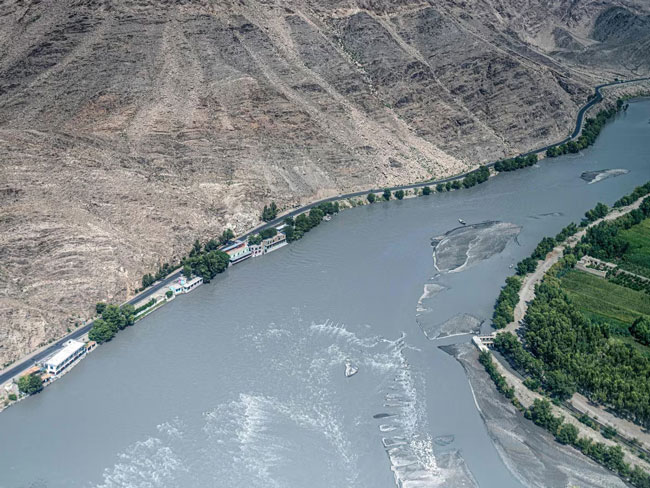
Amid ongoing tensions with Pakistan and rising cross-border hostilities, India has prolonged its assist to Afghanistan — a transfer that carries each symbolic and strategic weight. New Delhi has not solely backed the Taliban authorities’s plan to construct a dam on the Kunar River, but in addition reaffirmed its dedication to Afghanistan’s sovereignty and rights over its pure assets.
This growth comes shortly after India suspended the Indus Water Treaty with Pakistan following the Pahalgam terror assault — signaling a broader strategic shift in South Asia’s hydro-politics.
🔹 India Stands for Afghanistan’s Sovereignty
Throughout his weekly press briefing, Overseas Ministry spokesperson Randhir Jaiswal acknowledged that India helps all reliable and development-oriented initiatives of Afghanistan. He emphasised that each nations share a longstanding partnership within the discipline of water administration and hydropower growth — notably citing the Salma Dam in Herat province as a profitable instance of such cooperation.


Jaiswal mentioned,
“India stays dedicated to supporting Afghanistan’s efforts in sustainable water administration and hydropower growth. It’s Afghanistan’s sovereign proper to make use of its pure assets for its personal progress.”
🔹 Taliban Pushes Home Corporations to Construct the Dam
Final week, Taliban chief Hibatullah Akhundzada instructed Afghanistan’s Ministry of Power and Water to expedite building of the Kunar River dam.
In line with experiences, Minister Abdul Latif Mansoor revealed that Akhundzada has ordered officers to not look forward to international firms and to start the mission by home corporations underneath native contracts.
This transfer indicators the Taliban regime’s intent to pursue financial self-reliance, regardless of sanctions and worldwide isolation.
🔹 Pakistan’s Anger and Regional Implications
India’s open endorsement of the mission has angered Pakistan, which fears that the dam may disrupt the water move and irrigation methods feeding its northwestern areas. The Kabul River, which receives waters from the Kunar, is a vital lifeline for Pakistan’s Khyber Pakhtunkhwa province.
Responding to Islamabad’s objections, the Indian Overseas Ministry acknowledged —
“Pakistan seems to be upset that Afghanistan is exercising its sovereignty. It appears Pakistan believes it has a proper to conduct cross-border terrorism with impunity.”
This sharp assertion displays not only a diplomatic stance, but in addition a strategic message — India will now prioritize regional sovereignty and cooperation over Pakistan’s sensitivities.
🔹 The Kunar River: A Supply of Energy and Politics
The Kunar River is one in every of Afghanistan’s 5 main rivers, originating in Pakistan’s Chitral area and flowing for about 482 kilometers by Afghanistan’s Kunar province earlier than becoming a member of the Kabul River, which in the end flows again into Pakistan.
Specialists recommend that the proposed dam may rework Afghanistan’s vitality independence, bolster irrigation methods, and strengthen its water safety — all whereas decreasing downstream dependency on Pakistan.
🔹 India-Afghanistan Ties: Deepening Strategic Cooperation
In the course of the Taliban Overseas Minister Amir Khan Muttaqi’s go to to India in early October, each side had already mentioned cooperation in hydropower and sustainable water administration.
The joint assertion launched on the time made clear that India is “able to assist Afghanistan’s growth efforts, together with within the discipline of sustainable water administration.”
India’s newest endorsement of the Kunar mission thus seems as a continuation of that coverage, turning phrases into motion.
🔹 Conclusion
India’s transfer is extra than simply an endorsement of a dam — it’s a strategic declaration.
By aligning with Afghanistan’s sovereign water mission, New Delhi has challenged Islamabad’s historic dominance over regional water narratives.
For Afghanistan, the Kunar Dam represents hope for vitality and agricultural stability.
For India, it’s a geopolitical funding — one that might reshape South Asia’s water diplomacy for years to return.