
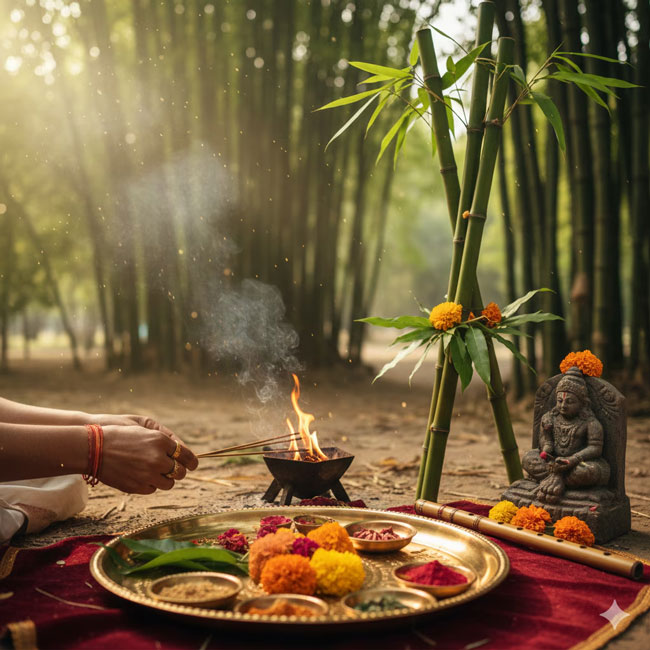
In the huge panorama of Hindu perception, each tree, plant, and pure ingredient carries not simply bodily but additionally  non secular and symbolic that means. Amongst these, bamboo — identified in Sanskrit as “Vansh” — holds a uniquely sacred place.
The concept that burning bamboo is inauspicious isn’t a superstition born of worry, however a knowledge rooted in symbolism, ecology, and reverence for all times itself.
1. Bamboo because the Image of Lineage (Vansh)
In Sanskrit, vansh actually means household, lineage, or era. The phrase itself varieties the foundation of many household names in India.
Due to this symbolic connection, burning bamboo got here to symbolize destroying one’s personal lineage — a metaphorical act of reducing the continuity of life.
Folks perception holds that those that burn bamboo invite sorrow or stagnation into their household life. In essence, it isn’t the bamboo that burns, however the image of 1’s personal lineage.
2. The Ecological and Sensible Knowledge
Historical traditions typically hid profound environmental knowledge inside spiritual beliefs. Bamboo is among the many most helpful and sustainable crops — utilized in building, furnishings, music devices, and even in spiritual rituals.
To burn it will imply to waste a treasured useful resource and hurt the setting. Thus, by labeling bamboo-burning as “inauspicious,” the ancients impressed a tradition of preservation relatively than destruction.


3. The Sole Exception — Throughout Funerals
There may be one notable exception the place bamboo does meet hearth — throughout Hindu funerary rites (Antyeshti).
The physique is carried to the cremation floor on a bier product of bamboo sticks, which ultimately burn with the pyre. Right here, nevertheless, the symbolism modifications: bamboo turns into the bridge between life and liberation, between the bodily and the everlasting.
This act isn’t thought of inauspicious, however relatively an important a part of returning the physique to the cosmic cycle.
4. References in Scriptures and Folklore
Sure Puranas, such because the Garuda Purana and Vayu Purana, trace at this perception by declaring that “he who burns vansh invitations the destruction of his personal clan.”
Folks sayings throughout rural India echo the identical sentiment:
“Burn the bamboo, and also you burn your individual residence’s fortune.”
By way of such expressions, generations internalized the concept that to destroy bamboo was to disrupt the pure rhythm of continuity.
5. The Deeper Message
The true essence of this perception lies not in worry however in philosophy.
Bamboo grows swiftly, multiplies abundantly, bends with the wind but not often breaks — an ideal metaphor for resilience, adaptability, and the continuity of life.
Not burning bamboo is thus an affirmation of life over destruction, creation over consumption. It reminds us to nurture what sustains us — household, nature, and custom.
Conclusion
The taboo in opposition to burning bamboo reveals the refined intelligence of Hindu tradition — a concord between symbolism, ecology, and spirituality.
Behind this straightforward prohibition lies a profound reality:
that our lineage, our timber, and our planet should not issues to be consumed by hearth, however to be preserved as sacred extensions of ourselves.
In selecting to not burn the bamboo, our ancestors have been actually saying —
“Don’t burn your roots; allow them to develop, allow them to dwell.”